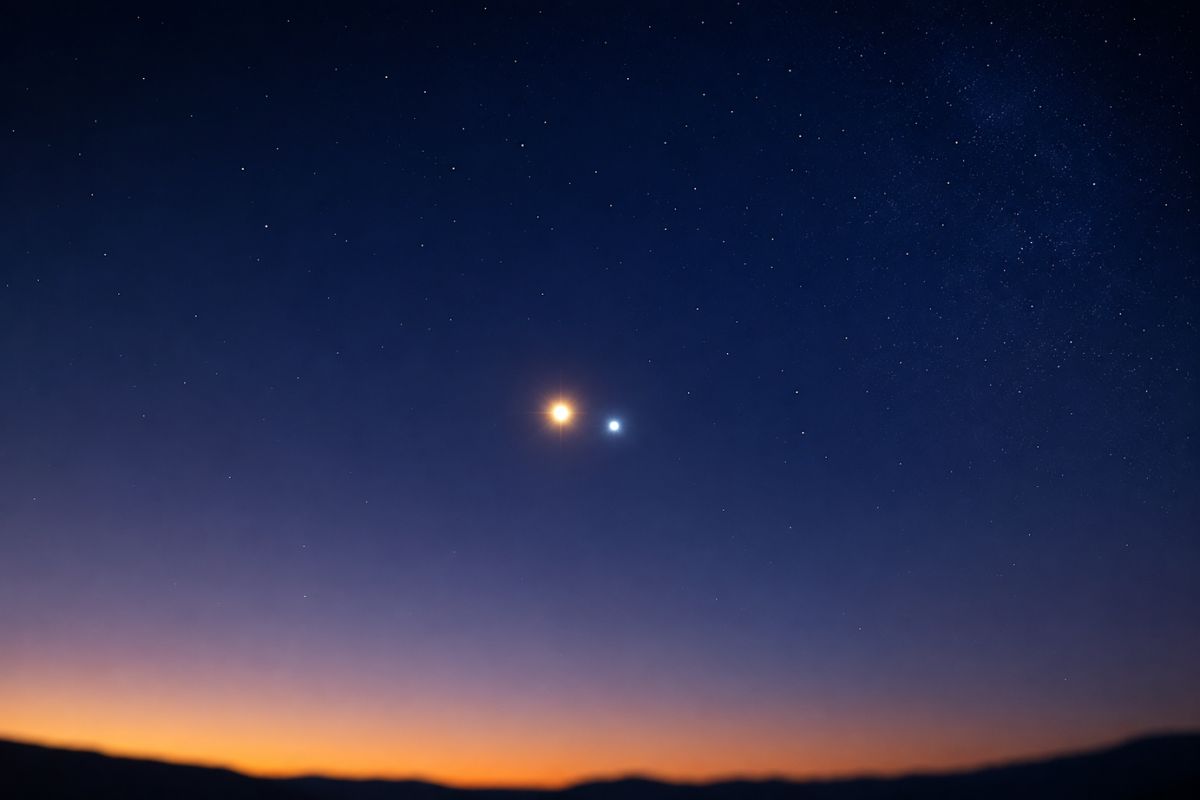
The Winter Solstice Great Conjunction refers to the exceptionally close Jupiter-Saturn conjunction that occurred on 21 December 2020, the same day as the December solstice. There is no Jupiter-Saturn Great Conjunction on the winter solstice in 2026. The next Great Conjunction is expected in November 2040, although Jupiter and Saturn will appear much farther apart than they did in 2020.
The 2020 event attracted worldwide attention because Jupiter and Saturn appeared exceptionally close together in the evening sky. NASA reported that the two planets appeared only about 0.1 degrees apart, making the event the closest Jupiter-Saturn conjunction visible from Earth since 1226.
But what exactly made the event so unusual, and what can skywatchers expect next?
What Was the Winter Solstice Great Conjunction?
The Winter Solstice Great Conjunction was the Jupiter-Saturn conjunction that took place on 21 December 2020.
A “Great Conjunction” is the apparent close alignment of Jupiter and Saturn in Earth’s sky. These conjunctions occur roughly every 20 years because of the planets’ orbital periods.
The 2020 event was particularly special because:
- It occurred on the December solstice.
- Jupiter and Saturn appeared only about 0.1 degrees apart.
- It was the closest Jupiter-Saturn conjunction since 1623.
- It was the closest observable conjunction of the pair since 1226.
- The planets were bright enough to see without a telescope in suitable conditions.
The coincidence between the conjunction and the solstice was not caused by the two events being physically connected. NASA explains that the conjunction depends on the orbital positions of Jupiter, Saturn and Earth, while the solstice is determined by Earth’s axial tilt.
Is There a Winter Solstice Great Conjunction in 2026?
No. There is no Jupiter-Saturn Great Conjunction coinciding with the winter solstice in 2026.
This distinction is important because searches for “winter solstice great conjunction 2026” may suggest that the famous event is happening again.
It is not.
The historic event occurred on 21 December 2020. Jupiter and Saturn do not have another Great Conjunction on the 2026 winter solstice.
The next Jupiter-Saturn Great Conjunction is expected in November 2040. It will be a genuine Great Conjunction, but the planets will appear approximately 1.1 degrees apart — considerably farther apart than they were in 2020.
2026 update
Latest status: As of 2026, the term “Winter Solstice Great Conjunction” primarily refers to the historic 2020 Jupiter-Saturn event. There is no equivalent winter-solstice Jupiter-Saturn Great Conjunction scheduled for 2026.
What Is a Great Conjunction?
In astronomy, a conjunction occurs when two celestial objects appear close together in the sky from our viewpoint on Earth.
A Great Conjunction traditionally refers specifically to a conjunction between Jupiter and Saturn, the two largest planets in the Solar System.
The planets are not actually close together in space during a conjunction.
Instead, their orbital positions make them appear close when viewed from Earth.
NASA compares the Solar System to a racetrack: Jupiter and Saturn travel around the Sun in different lanes and at different speeds. Jupiter completes an orbit in about 12 years, while Saturn takes about 30 years. Their positions therefore periodically line up from Earth’s perspective.
Why Was the 2020 Great Conjunction So Special?
Great Conjunctions occur approximately every 20 years, but they are not all equally close.
The 2020 conjunction was exceptional because Jupiter and Saturn appeared just one-tenth of a degree apart.
For comparison, NASA explained that most Jupiter-Saturn conjunctions bring the planets within about one degree of one another. In 2020, they appeared roughly ten times closer.
The closeness also meant that observers could see both planets within the same field of view through some small telescopes.
NASA described the 2020 event as the closest conjunction since 1623 and the closest visible from Earth since the medieval conjunction of 1226.
Why Did It Happen on the Winter Solstice?
The conjunction happened on 21 December 2020, which was also the December solstice.
In the Northern Hemisphere, the December solstice is the winter solstice, marking the shortest day and longest night of the year.
However, the two events were essentially a coincidence.
The date of a planetary conjunction is determined by the positions and orbital movements of the planets. The solstice occurs because Earth’s rotational axis is tilted relative to its orbit around the Sun.
NASA specifically notes that a conjunction can occur on any date, depending on the planets’ positions, whereas the solstice is determined by Earth’s axial tilt.
This is why it is more accurate to describe the 2020 event as a Great Conjunction that coincided with the winter solstice, rather than suggesting that the solstice caused the conjunction.
When Was the Last Winter Solstice Great Conjunction?
The last and most famous winter-solstice Great Conjunction occurred on:
Date: 21 December 2020
Planets: Jupiter and Saturn
Approximate separation: 0.1 degrees
Event: Great Conjunction
Occasion: December solstice
Visibility: Naked-eye under suitable conditions
The planets appeared low in the southwestern sky shortly after sunset and could be seen without specialised equipment. Binoculars or a small telescope offered an even better view.
Also Read: Who Is Kaziah Liz Mejo? The New Miss Universe India 2026
When Is the Next Great Conjunction?
The next Jupiter-Saturn Great Conjunction is expected in November 2040.
It will not, however, replicate the exceptional closeness of the 2020 event.
According to astronomical calculations compiled by timeanddate.com, Jupiter and Saturn will be approximately 1.1 degrees apart during the 2040 conjunction. The next conjunction with a separation comparable to the 2020 event is expected in 2080.
Jupiter-Saturn Great Conjunction timeline
| Year | Event | Approximate separation |
|---|---|---|
| 2000 | Jupiter-Saturn conjunction | 1.15° |
| 2020 | Exceptional Great Conjunction | 0.10° |
| 2040 | Next Great Conjunction | ~1.1° |
| 2060 | Great Conjunction | ~1.1° |
| 2080 | Another exceptionally close conjunction | ~0.1° |
The 2020 event was therefore unusual not because Great Conjunctions are extremely rare, but because this particular conjunction was exceptionally close.
How Often Does the Great Conjunction Occur?
A Jupiter-Saturn Great Conjunction occurs roughly every 20 years.
This happens because Jupiter and Saturn have different orbital periods around the Sun. Jupiter takes about 12 years to orbit the Sun, while Saturn takes about 30 years.
From Earth, their positions periodically line up in the sky, creating the appearance that the two planets are meeting.
However, the exact separation between them varies from one conjunction to another.
Some conjunctions are relatively wide, while others bring the planets much closer together.
Will the Next Great Conjunction Be as Close as 2020?
No.
The 2040 Great Conjunction will be significantly wider than the 2020 event.
The 2020 conjunction had an angular separation of approximately 0.10 degrees, while the 2040 conjunction is expected to be around 1.1 degrees.
That means the planets will still appear relatively close together, but they will not produce the same extremely tight visual pairing seen in December 2020.
For another Jupiter-Saturn conjunction comparable to 2020 in apparent closeness, skywatchers will have to wait until 2080.
Is the Great Conjunction the Same as the “Christmas Star”?
The 2020 Jupiter-Saturn conjunction was sometimes called the “Christmas Star” because of its timing in December and its striking appearance.
However, “Christmas Star” is a popular description rather than the formal astronomical name for the event.
NASA discussed the popular “Christmas Star” description when explaining the 2020 conjunction.
The astronomical event itself was a Jupiter-Saturn Great Conjunction.
It is also important not to confuse the 2020 event with historical or religious interpretations of the Star of Bethlehem. The scientific observation is that Jupiter and Saturn appeared unusually close together in Earth’s sky.
Also Read: Kashmiri Pandits Face Fresh Online Threat as Hit List Reveals Personal Details
Can You See a Great Conjunction Without a Telescope?
Yes.
Jupiter and Saturn are bright planets, so a Great Conjunction can be visible to the naked eye when the planets are above the horizon and the sky is sufficiently dark and clear.
For the 2020 event, NASA recommended finding an unobstructed view and looking towards the southwestern sky after sunset.
A pair of binoculars can make the observation more interesting, while a small telescope may reveal additional details.
During the 2020 conjunction, observers using optical equipment could see Jupiter’s major moons and Saturn’s rings.
How to Watch the Next Jupiter-Saturn Great Conjunction
When the next Great Conjunction approaches, skywatchers should check an up-to-date astronomical almanac or reputable observatory for the exact viewing time and direction.
The best viewing conditions generally include:
- A clear sky
- Minimal light pollution
- An unobstructed horizon
- Knowledge of the local sunset time
- A suitable viewing location
- Binoculars or a telescope for enhanced views
The exact visibility will vary depending on the observer’s location.
For this reason, viewing information for a future conjunction should be checked closer to the event rather than relying on a generic timetable published years in advance.
Also Read: Interesting Facts About Raksha Bandhan
What Makes the Winter Solstice Great Conjunction Different?
The phrase combines two separate astronomical concepts:
Winter solstice: A seasonal event caused by Earth’s axial tilt.
Great Conjunction: The apparent alignment of Jupiter and Saturn caused by their orbital positions relative to Earth.
The 2020 event became particularly memorable because these two events occurred on the same date.
This coincidence created an unusually strong combination of astronomical and seasonal interest.
Winter Solstice Great Conjunction: 2026 SEO Update
For people searching for the latest Winter Solstice Great Conjunction information in 2026, the key facts are:
- The famous event occurred on 21 December 2020.
- It involved Jupiter and Saturn.
- The planets appeared approximately 0.1 degrees apart.
- The conjunction coincided with the December/winter solstice.
- There is no equivalent Jupiter-Saturn Great Conjunction on the winter solstice in 2026.
- The next Jupiter-Saturn Great Conjunction is expected in November 2040.
- The next similarly close conjunction is expected in 2080.
This distinction is important for anyone publishing or searching for current astronomy information in 2026.
Frequently Asked Questions
What is the Winter Solstice Great Conjunction?
The Winter Solstice Great Conjunction refers to the exceptionally close Jupiter-Saturn conjunction that occurred on 21 December 2020, coinciding with the December solstice.
Is there a Great Conjunction in 2026?
There is no Jupiter-Saturn Great Conjunction on the winter solstice in 2026. The next Jupiter-Saturn Great Conjunction is expected in November 2040.
When was the last Great Conjunction?
The last Jupiter-Saturn Great Conjunction occurred on 21 December 2020.
How close were Jupiter and Saturn in 2020?
They appeared approximately 0.1 degrees apart in Earth’s sky.
When is the next Jupiter-Saturn conjunction?
The next Great Conjunction is expected in November 2040.
Will Jupiter and Saturn be as close in 2040 as they were in 2020?
No. The 2040 conjunction is expected to have a separation of approximately 1.1 degrees, compared with about 0.1 degrees in 2020.
When will another conjunction be as close as the 2020 event?
A similarly close Jupiter-Saturn conjunction is expected in 2080.
Can the Great Conjunction be seen with the naked eye?
Yes. Jupiter and Saturn are bright enough to be visible without a telescope when viewing conditions are favourable.
Is the Winter Solstice Great Conjunction related to the Star of Bethlehem?
The 2020 conjunction was popularly nicknamed the “Christmas Star”, but this is a popular description rather than the astronomical name of the event. The scientific event was a Jupiter-Saturn Great Conjunction.
Final Thoughts
The Winter Solstice Great Conjunction remains one of the most memorable recent astronomical events.
On 21 December 2020, Jupiter and Saturn appeared extraordinarily close together in the evening sky. The event was especially notable because it coincided with the winter solstice and produced the closest observable Jupiter-Saturn pairing since 1226.
There is no repeat of that event in 2026. However, the Jupiter-Saturn cycle continues. The next Great Conjunction is expected in November 2040, followed by another in 2060 and a particularly close one in 2080.
For SEO and factual accuracy, it is therefore better to treat “winter solstice great conjunction” as an evergreen historical topic with a 2026 update, rather than presenting it as a new 2026 astronomical event.
References:
- NASA: The “Great” Conjunction of Jupiter and Saturn
- NASA: Jupiter-Saturn Great Conjunction
- Timeanddate: Great Conjunction of Jupiter and Saturn
- NASA/JPL: What’s Up — December 2020