Quick Answer: Nishita Kaal is the calculated midpoint of the night—the exact window Hindu tradition points to as the moment Krishna was born. On Janmashtami, this is when the main puja happens: the abhishek, the cradle ceremony, and the aarti. Not at a fixed clock time like midnight, but at a muhurat that moves every year and in every city, based on local sunset and sunrise. For New Delhi in 2026, that window runs from 11:57 PM on 4 September to 12:43 AM on 5 September. Just 46 minutes. By tradition, it’s the most spiritually charged stretch of the entire festival.
So what happens in those 46 minutes? And why does Hindu tradition treat this window as more important than the rest of the day put together?
What Is Nishita Kaal, Exactly?
Nishita Kaal isn’t a Janmashtami-only concept. Devotees know it best from Maha Shivratri, where the same midnight period marks the most sacred hour of Shiva worship. The word comes from two Sanskrit roots: nishith, the deepest and stillest part of the night, and kaal, time.
Traditional panchang-makers split the night—from sunset to the following sunrise—into fifteen equal segments called muhurtas. Nishita Kaal is the eighth of those, sitting right at the midpoint. Nights get longer or shorter through the year, and sunset and sunrise shift with longitude too. Which means Nishita Kaal is almost never exactly 12:00 AM. It can land a few minutes either side of midnight, and between two cities, the gap can stretch past half an hour.
Here’s the detail most people get wrong: Nishita Kaal and “midnight” are cousins, not twins. Midnight is a fixed clock convention. Nishita Kaal is worked out fresh for every date and every location. That’s why a Mumbai panchang and a Kolkata panchang can show quite different Nishita timings for the same festival night—sometimes an hour apart.
Also Read: Karwa Chauth 2026: Date, Shubh Muhurat, Moonrise Time and Puja Vidhi
Why Nishita Kaal Matters Specifically on Janmashtami
Janmashtami marks Krishna’s birth, and tradition places that birth at midnight—on the Ashtami tithi of Krishna Paksha, in the month of Bhadrapada, under Rohini Nakshatra. Since the birth itself sits at this hour, the puja follows the same clock. Everything earlier in the day—the vrat, decorating the cradle, the early bhajans—is preparation. The moment temples and panchangs are treated as non-negotiable is Nishita Kaal itself.
That’s also why the calendar date trips people up so often. Say the festival is marked for 4 September, but the main puja window doesn’t open until nearly midnight and runs well past it. The celebration, on the clock, spills into 5 September—even though the festival date itself never moves. The date comes from the tithi active at sunrise or through most of the day. The puja timing is worked out separately, from the midpoint of that particular night.
What Actually Happens During Nishita Kaal
Strip away regional differences, and the core sequence looks broadly the same across homes, temples, and ISKCON centres:
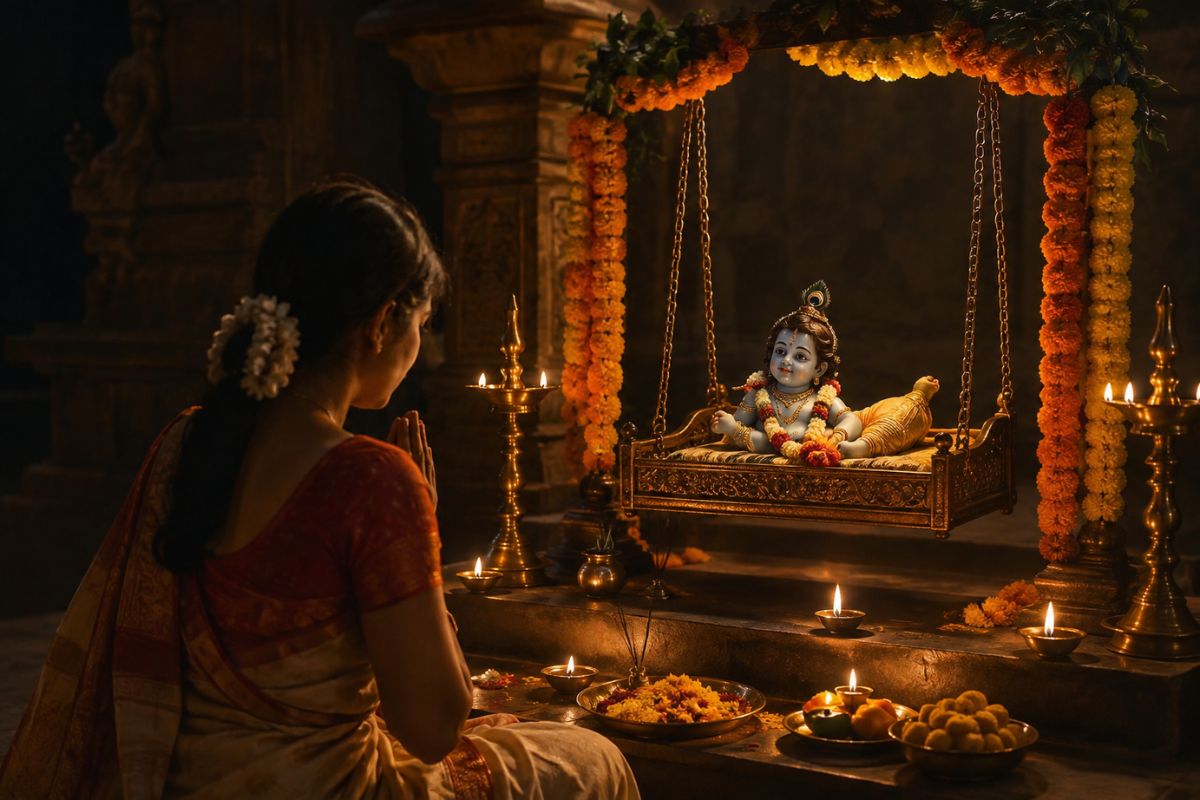
- The idol is set up. A murti, or image of an infant Krishna, goes into a small decorated cradle before the muhurat begins.
- Abhishek. Once the Nishita window opens, the idol is bathed—usually with milk, curd, honey, and ghee, sometimes Ganga water, in the panchamrit tradition.
- Dressing. New clothes and ornaments go on right after the abhishek.
- The cradle ceremony. The idol is placed in the cradle and gently rocked while devotees sing bhajans.
- Conches and bells. Many temples mark the “birth” moment within the window by sounding conch shells and bells—probably the most recognisable part of the whole observance.
- Aarti. A closing aarti follows once the core rituals wrap up.
- Prasad. Makhan-mishri, or panjeeri, is offered to the deity first, then handed out to devotees.
All of it usually happens inside the muhurat window itself. That’s exactly why the start and end times matter so much—a 46-minute window, like Delhi’s in 2026, doesn’t leave much room to run late.
Janmashtami 2026: Nishita Kaal Timings
Janmashtami 2026 falls on Friday, 4 September, based on the Drik Panchang calculation most widely followed across India. For New Delhi, the key windows are:
| Element | Details |
|---|---|
| Janmashtami Date | Friday, 4 September 2026 |
| Ashtami Tithi | 2:25 AM, 4 September – 12:13 AM, 5 September |
| Rohini Nakshatra | 12:29 AM – 11:04 PM, 4 September |
| Nishita Puja Muhurat | 11:57 PM, 4 September – 12:43 AM, 5 September |
| Parana (Fast-Breaking) | After 6:02 AM, 5 September (Dharma Shastra rule); ISKCON parana around 6:01 AM |
Nishita Kaal is tied to local sunset and sunrise, so the window moves from city to city. Here’s how it lines up in 2026 for some of the major centres of Janmashtami observance:
| City | Nishita Puja Window |
|---|---|
| New Delhi | 11:57 PM, 4 Sept – 12:43 AM, 5 Sept |
| Mumbai | 12:14 AM – 1:01 AM, 5 Sept |
| Kolkata | 11:13 PM – 11:59 PM, 4 Sept |
| Bengaluru | 11:55 PM, 4 Sept – 12:42 AM, 5 Sept |
| Chennai | 11:45 PM, 4 Sept – 12:31 AM, 5 Sept |
| Hyderabad | 11:52 PM, 4 Sept – 12:38 AM, 5 Sept |
| Pune | 12:10 AM – 12:57 AM, 5 Sept |
| Jaipur | 12:03 AM – 12:49 AM, 5 Sept |
| Ahmedabad | 12:16 AM – 1:02 AM, 5 Sept |
| Vrindavan / Mathura | 11:56 PM, 4 Sept – 12:41 AM, 5 Sept |
| Varanasi | 11:34 PM, 4 Sept – 12:20 AM, 5 Sept |
| Chandigarh | 11:59 PM, 4 Sept – 12:45 AM, 5 Sept |
Treat these as general calculations. They can shift by a few minutes depending on which panchang source you use, so if you’re organising something bigger than a home puja—a temple event, say—check a local panchang closer to the date.
Also Read: Weather in Tirupati for Next 15 Days: Complete Forecast
An Overlap Worth Noting: Rohini Nakshatra in 2026
Here’s a detail most Janmashtami coverage skips entirely. Krishna’s birth is traditionally tied to both Ashtami tithi and Rohini Nakshatra occurring together — a pairing sometimes called “Ashtami Rohini.” But tithi and nakshatra move on separate clocks. They don’t line up every year.
In New Delhi’s 2026 calculation, Rohini Nakshatra ends around 11:04 PM on 4 September. The Nishita Puja window doesn’t start until 11:57 PM. So Rohini has already wrapped up by the time the main midnight puja begins—no overlap this year, at least in the capital. None of this takes away from the festival’s meaning. It just means 2026 doesn’t reproduce the exact “Ashtami Rohini” combination tied to the original birth story. Worth remembering next time a Janmashtami article treats every year as identical.
What Comes After Nishita Kaal: Parana and the Rest of the Night
Once the puja wraps up, the next question is when the fast actually ends. This one splits by tradition. Some devotees, and many ISKCON centres, break the fast right after the midnight celebration finishes. Others stick to the stricter Dharma Shastra rule—for New Delhi in 2026, that puts the earliest parana after 6:02 AM on 5 September, once Ashtami tithi has fully run its course. Both conventions are common enough that you’ll see different sources quote different “correct” parana times for the same night. Neither is wrong. Follow whichever rule your family or sampradaya uses.
For a lot of people, the night doesn’t stop there either. Mathura, Vrindavan, and Barsana often keep going well past the core puja—extended kirtan, lit-up temples, and community gatherings running toward dawn. In Maharashtra and Goa, the mood shifts the next day into Dahi Handi, the Govinda festival, where teams form human pyramids to break a curd-filled pot hung overhead—a reenactment of young Krishna’s butter-theft stories. That falls on Saturday, 5 September 2026, the day right after Janmashtami.
Why This Matters Beyond Ritual Mechanics
It’s tempting to read all this as pure scheduling—muhurats, tithis, city tables. But the idea underneath is older and plainer than the math suggests. Nishita Kaal is one of a handful of points on the Hindu calendar—Maha Shivratri’s midnight worship being the other big one—where tradition deliberately hands spiritual weight to the quietest part of the night. The reasoning is simple: a stiller world makes for a steadier mind. Janmashtami’s midnight puja isn’t midnight for convenience. It’s midnight because that’s when the birth it marks is remembered as happening, and the ritual tries to meet that moment honestly instead of just approximating it.
If you can’t make it to a temple or can’t stay up through the full window, most guidance lands on the same point anyway: a few minutes of sincere prayer, a lit diya, and some quiet reflection during the window carry the same weight as an elaborate ceremony. The muhurat’s precision matters for getting the ritual right. The sincerity behind it is what tradition keeps insisting is the part that actually counts.
Also Read: 12 Famous Indian Cities and What They Are Known For
Frequently Asked Questions
Is Janmashtami 2026 on 4 or 5 September?
Janmashtami is observed on Friday, 4 September 2026, per the standard panchang calculation for New Delhi. The confusion comes from the Nishita Puja Muhurat, which starts late on 4 September and runs past midnight into 5 September.
What time is Nishita Kaal on Janmashtami 2026?
For New Delhi: 11:57 PM on 4 September to 12:43 AM on 5 September, roughly 46 minutes. It varies by city—Mumbai’s window, for example, starts around 12:14 AM.
Why is the midnight puja considered more important than the rest of the day’s rituals?
Krishna’s birth is traditionally placed at midnight, so the puja during Nishita Kaal is treated as the direct commemoration of that moment. The day’s earlier fasting and rituals are considered preparation for it.
Is Nishita Kaal the same as clock midnight?
Not quite. Midnight is fixed at 12:00 AM. Nishita Kaal is calculated from the actual gap between sunset and sunrise for a given date and city, so it can land a little before or after midnight depending on the season.
Does Rohini Nakshatra always overlap with Nishita Kaal on Janmashtami?
No. Tithi and nakshatra run on separate cycles, so the overlap changes by year and city. In New Delhi in 2026, Rohini Nakshatra ends before the Nishita Puja window even opens.
When can the Janmashtami fast be broken in 2026?
Depends on tradition. The Dharma Shastra-based parana time for New Delhi is after 6:02 AM on 5 September. Many ISKCON centres, though, break the fast shortly after the midnight puja ends.
Do I have to stay awake through the entire night to observe Janmashtami properly?
No. The emphasis is on sincere worship during the Nishita window, not on staying up all night. Elderly people, pregnant women, and anyone managing a health condition should adapt the observance to what their body can actually handle.
Sources & References
- Economic Times – “Janmashtami 2026: Date, Puja Muhurat, Nishita Kaal and Parana Time — Complete Guide,”
- DivineTalk – “Janmashtami 2026 Nishita Kaal: Krishna Puja Muhurat, 4 or 5 September Exact Timing Explained,”
- The Sanatan Tales – “Nishit Kaal: Meaning & FAQ,”
- Sanatana Journey Divine Store – “Krishna Janmashtami 2026: Date, Nishita Puja Vidhi, Vrat Katha,”
Timings here are calculated for New Delhi unless noted otherwise, based on standard panchang conventions. Exact minute-level figures can vary slightly by source—confirm against a location-specific panchang closer to the date.