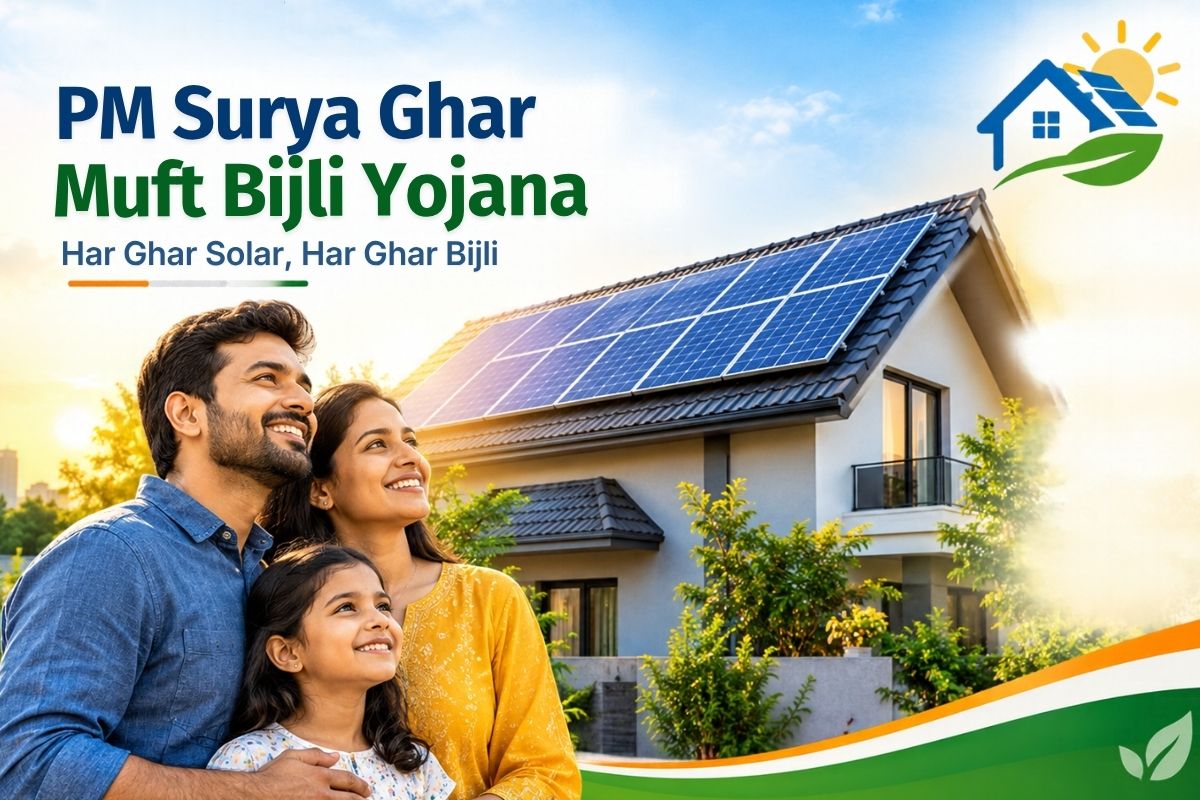
Yes. The Central Government Solar Panel Scheme, officially known as the PM Surya Ghar Muft Bijli Yojana, pays homeowners a subsidy of ₹30,000 per kW for the first 2 kW and ₹18,000 for the third kW, capped at ₹78,000. It’s a refund after installation, not free panels, and applications run through PM Surya Ghar official website.
That’s the headline. The details decide whether you actually collect.
The scheme has an outlay of ₹75,021 crore and runs through FY 2026-27. By the national portal’s own counter on 9 October 2026, about 90 lakh applications had been filed, with roughly 51.7 lakh rooftop installations done and 61.4 lakh households benefiting. So this isn’t a pilot. Millions of people have been through the process, which means the failure modes are well known (more on those below).
The “Muft Bijli” (free electricity) in the name is marketing. What you get is a subsidy that cuts the cost of a grid-connected rooftop system, and then your own panels cut your bill.
How Much Subsidy Do You Get?
The subsidy is set by system size, with a hard cap at 3 kW. Scheme guidance describes it as 60% of the benchmark cost up to 2 kW and 40% of the additional cost between 2 and 3 kW.
| System Size | Standard States | Hilly / Special-Category Areas |
|---|---|---|
| 1 kW | ₹30,000 | ₹33,000 |
| 2 kW | ₹60,000 | ₹66,000 |
| 3 kW | ₹78,000 | ₹85,800 |
| 5 kW | ₹78,000 | ₹85,800 |
| 10 kW | ₹78,000 | ₹85,800 |
The hilly-area figures (about 10% higher) apply in places like Uttarakhand and Assam.
Two things people get wrong. First, a bigger system doesn’t earn a bigger subsidy. A 5 kW or 10 kW setup gets the same ₹78,000 as a 3 kW one, so the extra capacity is entirely your money. Second, you’ll see some pages claiming higher special-category amounts, one mentioning up to roughly ₹1,17,000. I couldn’t confirm that against an official source, so don’t plan around it until your DISCOM or the portal shows it.
Housing societies and RWAs have a separate track: ₹18,000 per kW for common facilities, up to 500 kW, with a maximum of ₹90 lakh.
Who is Eligible?
The basics: you’re an Indian citizen, you own a house with a roof suitable for panels, you have a valid electricity connection, and you haven’t taken any other solar subsidy. Installers add some practical conditions. Modules must be made in India and ALMM-approved. Your name also has to match across your Aadhaar, electricity bill, and bank account.
Before applying for the Government Solar Panel Scheme, check that you meet the residential eligibility requirements and have a valid electricity connection.
Who’s out: tenants, NRIs whose home isn’t their primary residence, commercial, industrial or agricultural connections, and anyone who already claimed a subsidy on that consumer number. The last one catches buyers of second-hand flats, because the one-time benefit stays with the connection.
If you live in an apartment, you can’t put panels on the shared roof and claim individually. The society route above is the one that works.
Also Read: Atal Pension Yojana (APY): Eligibility, Contributions and Pension Benefits
How to Apply, Step by Step
Do this in order. Skipping ahead is the most common way to lose weeks.
To apply for the Government Solar Panel Scheme, complete the registration and approval process through the official portal before installing your solar system.
- Register at the official website. Pick your state and DISCOM, enter your consumer account number, and verify your mobile number with an OTP.
- Submit the application with your details, matching your Aadhaar exactly.
- Wait for DISCOM feasibility approval. Don’t buy anything before this.
- Choose a registered vendor from your DISCOM’s approved list on the portal.
- Sign the agreement and have the vendor install the system.
- Apply for net metering. DISCOMs won’t issue the commissioning certificate until this is done.
- DISCOM inspects and issues the commissioning certificate.
- Upload the certificate plus your bank details and a cancelled cheque.
- Receive the subsidy by direct bank transfer. Installers quote roughly 30 to 45 days after commissioning.
Keep scans clear and under about 2 MB each. Blurry uploads get flagged before a human ever looks at them.
State Top-ups
Some states add their own money on top of the central ₹78,000. These numbers come from installer guides, so treat them as a starting point and confirm with your state nodal agency.
| State | Additional Subsidy / Benefit |
|---|---|
| Uttar Pradesh | ₹15,000 per kW, capped at ₹30,000 for systems of 2 kW and above |
| Delhi | ₹10,000 per kW, capped at ₹30,000 for systems of 3 kW and above |
| Assam | ₹15,000 per kW, capped at ₹45,000 for systems of 3 kW and above |
| Chhattisgarh | ₹15,000 per kW, capped at ₹30,000 for systems of 2 kW and above |
| Haryana | For eligible low-income households: up to ₹50,000 for annual income up to ₹1.8 lakh, or ₹20,000 for income between ₹1.8 lakh and ₹3 lakh. Applies to systems up to 2 kW. |
| Gujarat | New policy: Approved on 22 October 2026, for systems up to 2.18 kWp commissioned on or after that date. SC/ST consumers pay 5% of the benchmark cost, while other consumers pay 10%. |
The Gujarat row is a good example of how fast this moves. A guide checked on 14 October still reported no open top-up there. A week later the state announced one. If a page is more than a few weeks old, assume some row is wrong.
Delhi payouts are slower than the central one. The full process from application to credit usually runs 3 to 4 months.
The Last Date, and What Comes After
The official end date is 31 March 2027. Reports in 2026 say the Centre is considering a 3 to 4 month extension, but nothing has been notified.
My advice: plan for March 2027 and treat any extension as a bonus. Working backwards, an installation needs feasibility approval, installation, net metering, and inspection before the subsidy claim. If those take a couple of months in your DISCOM, an application filed in January is already tight. And nobody has announced what a successor scheme would pay. Waiting for a better one is a bet on a scheme that doesn’t exist yet.
What it Costs After Subsidy
Prices vary by city, brand, and roof type, so use your own quotes. As an illustration, a 3 kW system priced at ₹1.80 lakh, with the ₹78,000 subsidy, leaves a net investment of about ₹1.02 lakh.
For a 5 kW system, the arithmetic is the same: take your quote and subtract ₹78,000. If your quote were ₹3 lakh (an illustrative number, not a market price), you’d net ₹2.22 lakh. The subsidy covers a smaller share of the bill as the system grows, so size to your usage rather than to the roof.
Remember the subsidy arrives after commissioning. You pay the installer first.
Loans and Subsidy Together
Most households finance part of it. Two facts matter. The subsidy isn’t automatically applied to your loan, so people typically use it for a lump-sum prepayment once it lands. And bank processing has been slow: on 9 October 2026 the Finance Ministry asked banks to bring loan processing under 10 days, from about 17 days at public banks and 19 at private ones.
Ask your installer which banks they’ve actually closed loans with recently. Rates and terms differ between banks and borrowers, so get written quotes rather than relying on a headline rate.
Why Applications Stall
Most delays are boring.
- Name mismatches across Aadhaar, bill, and bank account. A missing middle name is enough.
- Wrong vendor. Only empanelled vendors can process claims.
- Non-compliant modules that aren’t on the approved list.
- Skipped net metering, which blocks the certificate.
- Wrong consumer category, such as a commercial connection applied as residential.
- Duplicate claims on a connection that already took the subsidy.
- Roof or technical infeasibility found at inspection, like too little shadow-free space.
Vendors cause delays too. MNRE deactivated 66 registered vendors for a month over backlogs of pending applications and advised vendors not to hold applications beyond 60 days without good reason. With over 37,000 vendors registered, quality varies. Before signing, ask how many systems the vendor has commissioned in your DISCOM area and how long their last few took.
Other Government Solar Schemes
PM Surya Ghar is the household one. Others you’ll run into:
- PM-KUSUM for farmers: a 30 to 50% subsidy on solar pumps, plus options for grid-connected plants on farmland.
- PM JANMAN solar component: ₹515 crore to power one lakh un-electrified households in particularly vulnerable tribal group areas through off-grid systems.
If you’re reading this from the US, UK or Pakistan, none of this applies. The US federal credit for purchased home solar ended on 1 January 2026; the UK has the Warm Homes Plan, and Punjab and Sindh in Pakistan run their own distribution drives.
Is a “Free Solar Panel” Offer Real?
No. Treat any “free solar panels from the government” pitch as a red flag. What the scheme makes free is some of your electricity after you install, not the hardware. Fake-scheme ads are common enough that an Australian fact-check found social media ads pushing a government rooftop scheme that doesn’t exist.
Warning signs: someone asks for a “registration fee” to reserve the subsidy, the pitch skips the national portal, or the vendor isn’t on your DISCOM’s list. Always verify any Government Solar Panel Scheme offer through the official portal before paying fees or sharing personal information.
FAQs
What is the maximum solar subsidy in India?
₹78,000 for a 3 kW system or larger, or ₹85,800 in hilly areas, plus any state top-up.
Can I get the subsidy if I rent?
Generally not. The scheme requires roof ownership and a qualifying connection in your household.
How long does the subsidy take to arrive?
After commissioning, installers quote roughly 30 to 45 days. State top-ups can take longer.
Is net metering mandatory?
Yes. Without it, you won’t get the commissioning certificate, and without that, there’s no subsidy.
Does a 5 kW system get more subsidy than 3 kW?
No. The cap is ₹78,000 from 3 kW upward.
Can apartments and housing societies apply?
Societies can, for common facilities. Individual flat owners usually can’t claim on a shared roof.