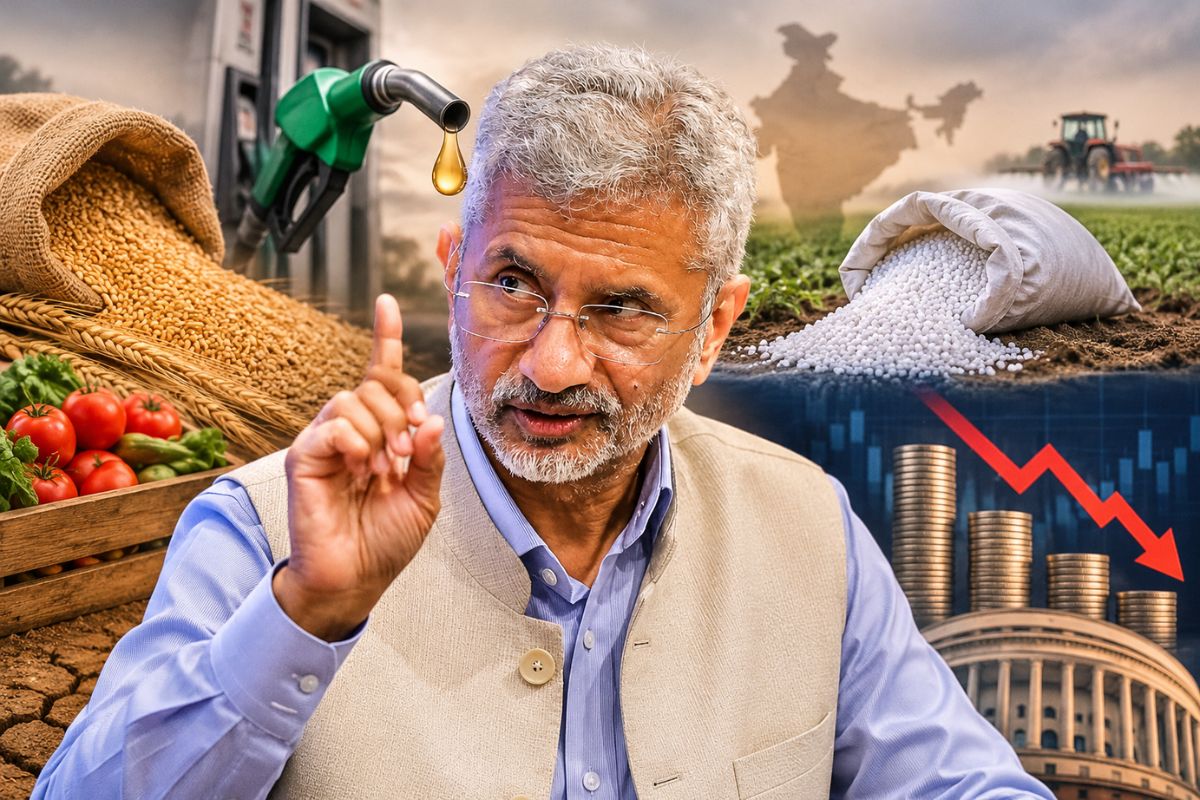
India is not facing a grain shortage right now, but it is facing a food-price and affordability squeeze, and the next few months matter. External Affairs Minister S. Jaishankar warned on 28 September 2026 that the world could see a major food crisis in the coming months and tied it to what he calls the “4F crisis”: food, fuel, fertiliser and finance. His warning was about the global system and the Global South. It was not a forecast of empty godowns in India. Still, India’s own numbers, from a weak monsoon to slower winter sowing to food inflation of 8.94% in October, show why the warning deserves attention.
- Jaishankar spoke at an Asia Society event in New York after UN General Assembly week and linked grain disruptions, fertiliser shortages, tight energy markets and financial stress.
- Global food prices are not at crisis levels: the FAO Food Price Index was 133.9 points in October 2026, down 1.2% from September but 5.9% above a year earlier.
- India’s central pool held 870.45 lakh tonnes of wheat and rice on 1 September 2026, a large cushion.
- The weak spots are the monsoon (12.6% deficient), rabi sowing (down about 11% as of 13 November), and retail food prices (8.94% inflation).
What Did Jaishankar Actually Say?
Speaking at the Asia Society in New York on 28 September, Jaishankar said there was going to be a major food crisis “probably in the coming months.” According to the All India Radio news report, he pointed to the conflicts in Ukraine and the Iran-Gulf region, disruptions to grain shipments from major exporters (particularly through the Black Sea), and fertiliser shortages. He described the energy market as already “very tight” and said key fertiliser producers in West Asia and Russia had been affected, while adverse climate patterns could worsen output.
He also argued that countries should not take decisions purely in their own interest when that pushes vulnerable nations into distress and that some countries may find it harder to preserve strategic autonomy. Several reports note that he had first used the “4F” label in his address to the UN General Assembly. On 25 October, he repeated that the Global South faces a 4F crisis and said the Global North has equal stakes in solving it.
Two details are easy to miss. First, the target of the warning was the developing world broadly, with India speaking as a voice for the Global South. Second, one analysis of the speech noted that it describes a risk building over the coming months, not a worldwide shortage that has already happened.
Also Read: India Price Hike From October 1, 2026: ACs, TVs, Cars, LPG and More That May Cost More Before Diwali
What Is The 4F Crisis?
The 4F crisis means food, fuel, fertiliser and finance. The idea is that these four problems feed each other. A conflict disrupts shipping or energy supplies, which raises fertiliser and food costs. Money then moves toward safe assets and away from the Global South, so governments have less foreign exchange to import food and energy or to support farmers. A country can have enough food today and still be in trouble if it cannot afford fertiliser for the next sowing season.
Where Do Global Food Prices Stand?
The FAO Food Price Index averaged 133.9 points in October 2026, down 1.6 points (1.2%) from September’s revised level. It remained 5.9% higher than in October 2025 and below the March 2022 record, which was set after Russia’s invasion of Ukraine.
The details matter more than the headline:
- Cereals fell 4.5% on the month to 116.8 points and were 12.6% below October 2025. FAO linked wheat’s decline to subdued demand, a better outlook in Argentina and an expected easing of Black Sea export constraints, though logistics problems there continue.
- Rice moved the other way, with the FAO All Rice Price Index up 1.6%, reflecting harvest delays in some exporters, bad weather and higher costs.
- Sugar rose 6.6% to 121.3 points, its fourth straight monthly increase, the highest since December 2024 and 28.8% above a year earlier.
So the global picture is mixed. Grain markets are well supplied for now. The risk Jaishankar described is mostly about inputs and the next harvests, not today’s grain price.
Why Does Fertiliser Sit At The Centre Of The Warning?
The conflict involving Iran began in late February 2026, and the Strait of Hormuz was closed to most commercial shipping for weeks. A research tracker cited by Global Agriculture says traffic has stayed well below normal since, despite a ceasefire framework agreed on 17 June. IFPRI reports that shipments through the strait fell back to near zero after hostilities resumed in mid-July.
The Gulf matters because it supplies a large share of the world’s urea and of the sulphur used to make phosphate fertiliser. The World Bank put the Middle East at almost a quarter of global urea exports in 2024. Other analysts estimate that about one-third of seaborne fertiliser trade was put at risk.
Prices have been volatile. IFPRI found urea almost 80% above its 1 January level in late April, then back at January levels by the end of August, while phosphate prices (DAP and MAP) rose 25% to 30% after the closure and stayed there. Early November brought fresh upward pressure: Egyptian granular urea was reported at about $535 a tonne for November contracts, roughly 17% above September, with Hormuz shipping risk and high sulphur prices cited as factors.
The main danger is quieter than a shortage. If farmers in poorer countries apply less fertiliser because it costs too much, yields can suffer in the 2026-27 harvest even when grain markets look calm today.
How Exposed Is India?
India is better protected than many countries, but not immune.
- Urea: India produces about 87% of the urea it uses and imports the rest, but roughly one-third of complex fertilisers, mainly DAP, are imported, according to East Asia Forum.
- Stocks: Government figures reported by Business Standard put fertiliser stocks at the start of the 2026-27 rabi season at 17.01 million tonnes, up 38% from last year, with urea at 8.33 million tonnes, up 54.26%. As of 16 October, total availability was 199.48 lakh tonnes, according to Agrospectrum.
- The cost: The Centre has absorbed price shocks through subsidies and spot purchases. East Asia Forum said in May that the fertiliser subsidy bill was likely to exceed ₹2 trillion.
- Local friction: Punjab farmers complained about DAP availability during wheat sowing, even as the state agriculture department said there was no shortage.
In short, India’s fertiliser problem so far looks like a budget and distribution issue, not an absolute supply gap.
Also Read: India Population in 2026: Current Population, Growth Rate, Density and Future Projections
What Is Going Wrong Inside India?
A weak monsoon
The 2026 southwest monsoon ended with 759.4 mm of rain against a long-period average of 868.6 mm, a 12.6% deficit, according to IMD data. Coverage describes it as the weakest season since 2015, an El Niño year. East and northeast India recorded about a 26% deficit and south peninsular India about 24%. Karnataka’s shortfall was around 35%. Central India fared better and stayed broadly within the normal range.
Slower winter sowing
As of 13 November, farmers had sown 178.25 lakh hectares of rabi crops against 201.04 lakh hectares a year earlier, a fall of about 11%. Wheat stood at 50.07 lakh hectares, down 15.27% from 59.10 lakh hectares. Pulses were down 14.34% at 47 lakh hectares. The ministry’s wheat target for 2026-27 is 336 lakh hectares, so sowing needs to speed up. Reports attribute the delay partly to October rain that disrupted kharif harvesting and partly to dry fields.
A fair caution: sowing runs through November and beyond, so these figures are not a final forecast. Wheat will be harvested in March and April 2027.
Rising food prices
Retail inflation rose to 6.09% in October from 5.54% in September, breaching the RBI’s 6% upper tolerance limit. Food inflation reached 8.94%, up from 7.74%, with rural food inflation at 9.09% and urban at 8.68%. Onion prices were up 116.22% on the year, while potato prices fell 14.24%.
One piece of context: base effects are inflating these percentages. Trading Economics’ compilation of MoSPI data shows food inflation hit a record low of minus 5.02% in October 2025. Prices were falling then, so a rebound looks steeper now. Even so, the direction is clear, and rural households, who spend more of their budget on food, feel it first.
What Buffers Does India Have?
This is where the “food crisis” label needs care. According to FCI data reported by Business Today, the central pool held 925.85 lakh tonnes of wheat and rice on 1 July 2026, more than twice the 411.20 lakh tonne norm. On 1 September it held 870.45 lakh tonnes: 479.92 of wheat and 390.53 of rice. Business Standard reports rice stocks of around 38 million tonnes on 1 October against a norm of 10.25 million tonnes.
Those reserves back the free-grain programme (PMGKAY), which reaches roughly 810 million people. A household going hungry because the country has run out of rice or wheat is a very different situation from a household cutting back because lentils, onions and cooking oil have become expensive.
How Is The Government Responding?
On 10 November, the Centre doubled its open-market rice sale target for 2026-27 to 5 million tonnes. About 2.5 million tonnes had already been sold through e-auctions by 31 October, against 1.1 million tonnes in the same period last year. It also required traders, wholesalers, retailers and millers to declare rice and paddy stocks weekly on the Food Stock Portal, allowed five southern states to set stock limits until 31 January 2027, and increased Bharat Rice allocations to NAFED, NCCF, and Kendriya Bhandar. An industry official quoted by Business Standard estimated rice output in the southern states at roughly 30% lower and national output about 10% lower, though that is an unofficial estimate.
So, Is India Heading Towards A Food Crisis?
The evidence supports a nuanced answer:
- Food availability: Strong in the near term, thanks to large central pool stocks.
- Food affordability: Under pressure, with food inflation near 9%.
- Farm output: At risk in the rabi season, especially wheat, pulses and oilseeds, if sowing does not catch up and El Niño-linked heat or dryness persists.
- Global inputs: Fertiliser and energy markets remain exposed to Hormuz and Black Sea disruptions.
Jaishankar’s message is best read as an early warning about interlinked risks, aimed at the Global South and at the countries with the power to ease these shocks. For India, the practical test arrives in the next few months: wheat sowing progress, the March-April harvest, and whether the rise in food prices cools.
What To Watch Next
- 4 December: FAO’s next Food Price Index release.
- 14 December: MoSPI’s CPI data for November.
- Weekly: Agriculture Ministry sowing reports on wheat, pulses and oilseeds.
- March-April 2027: The rabi harvest.
Also Read: India’s Temple Economy: How Pilgrimage Is Creating Jobs, Businesses, and Wealth in Small Towns
Frequently Asked Questions
What is the 4F crisis Jaishankar mentioned?
It stands for food, fuel, fertiliser and finance, four pressures he says are hitting developing economies together.
When and where did Jaishankar warn of a food crisis?
At an Asia Society event in New York on 28 September 2026, after the UN General Assembly’s high-level week.
Did he say India will face a food crisis?
No. He spoke of a possible global crisis that would hit the Global South hardest. India’s own exposure is a separate question, covered above.
Does India have enough grain?
Central pool stocks of wheat and rice were 870.45 lakh tonnes on 1 September 2026, well above buffer norms. The concern is prices and the coming rabi harvest.
How high is food inflation in India?
Consumer food price inflation was 8.94% in October 2026, with headline CPI at 6.09% (provisional data).
Are global food prices at record highs?
No. The FAO Food Price Index was 133.9 in October 2026, below its March 2022 record, though 5.9% above a year earlier.