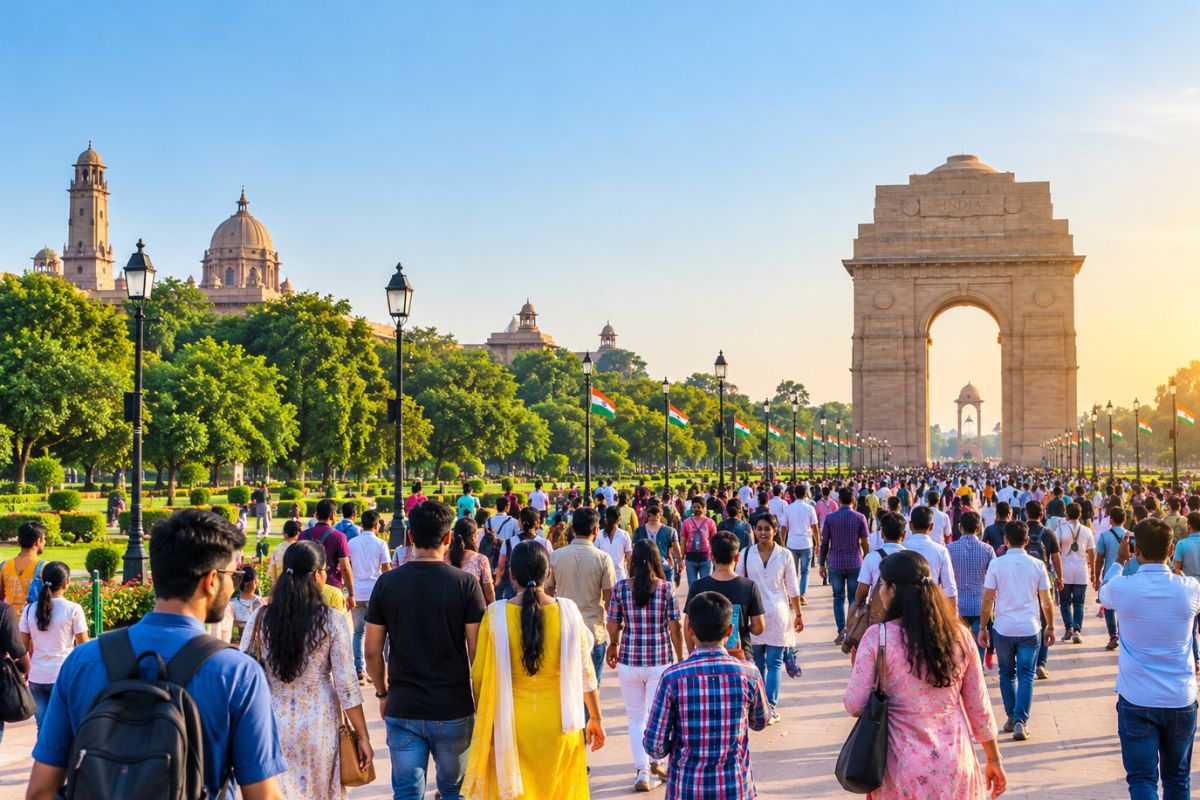
India is huge, no doubt about it. The country’s demographic landscape keeps shifting rapidly every single year. Right now in 2026, estimates pin the population at around 1.48 billion people. That translates to roughly 148 crore folks living here. So yes, it remains the most populous nation on Earth.
Having this massive crowd is a double-edged sword. On one hand, you get a massive young workforce and a booming consumer market. On the other hand, managing resources is a total headache. Urban areas are getting packed fast, which hits the environment and economy pretty hard. Still, India plays a critical role in global business.
In this post, let’s take an honest look at India’s numbers for 2026. We will dive into growth rates, density, age groups, urban shifts, big challenges, and what lies ahead.
1. What Is the Population of India in 2026?
The estimated headcount for India in 2026 stands at roughly 1,476,625,577 people. You can just round that off to 147.66 crore. It is a staggering number when you pause to think about it.
India moved past China back in 2023 to claim the top spot globally. Because of this scale, the country drives a huge chunk of global workforce trends and consumer spending daily. Oddly enough, staying at number one brings as many logistical nightmares as it does bragging rights.
Here is a quick snapshot of where things stand this year:
| Population Indicator | Estimated Figures |
|---|---|
| Total Population | 147.66 crore (1.476 billion) |
| Global Rank | 1st |
| Share of World Population | 17.8% |
| Annual Growth Rate | 0.87% |
| Population Density | 497 people per sq. km |
| Median Age | 29.2 years |
| Urban Population | ~55.53 crore (37.6%) |
| Rural Population | ~92.13 crore (62.4%) |
Keep in mind that these numbers come from the UN World Population Prospects 2024 projections. They are not official headcounts from a completed national census yet.
2. India’s Population Growth Over the Years
The total population has climbed steadily over the last few decades. Better hospitals, cleaner water, and decent living standards helped lower mortality rates overall. Naturally, people live longer now than they used to.
Let’s look at how the headcount shifted across these years:
| Year | Population (in Crores) | Population (in Billions) |
|---|---|---|
| 2000 | 105.79 crore | 1.057 B |
| 2005 | 115.47 crore | 1.154 B |
| 2010 | 124.35 crore | 1.243 B |
| 2015 | 132.80 crore | 1.328 B |
| 2020 | 140.26 crore | 1.402 B |
| 2024 | 145.09 crore | 1.450 B |
| 2025 | 146.39 crore | 1.463 B |
| 2026 | 147.66 crore | 1.476 B |
The total headcount keeps climbing, sure. But the actual growth pace has slowed down quite a bit compared to older decades. Families are simply getting smaller as fertility rates drop across most states.
3. Why Is India’s Population Growing?
Several underlying factors push the headcounts higher every year.
First off, healthcare services got much better over time. Routine vaccination drives and basic clinics reduced infant mortality significantly. As a direct result, average life expectancy went up across urban and rural zones.
Second, death rates dropped. Modern medical tools, better nutrition, and improved sanitation helped people live longer lives. You know, simple public health measures ended up saving millions of lives over time.
Third, India has a massive young population. The median age hovers around 29.2 years right now. Millions of young adults are entering marriage and childbearing years, which naturally sustains population momentum.
Finally, fertility rates vary wildly between regions. Northern states like Bihar and Uttar Pradesh maintain higher fertility rates around 2.5 to 3.0 children per woman. Meanwhile, southern states like Kerala and Tamil Nadu dropped well below the replacement rate of 2.1.
4. Population Density of India in 2026
Population density measures how many people live in one square kilometre of land area.
For 2026, India’s national average density hits about 497 people per square kilometre. That makes the country exceptionally crowded compared to the global average of roughly 60 people per square kilometre.
However, people do not spread out evenly. Some areas feel totally packed while others remain sparse.
Big hubs like Delhi, Mumbai, Kolkata, and Bengaluru draw millions every single year. Job opportunities, better colleges, and hospital facilities keep pulling folks from small towns. Delhi alone packs over 11,000 people per square kilometre in its central urban zones!
Unsurprisingly, extreme density stresses local resources. Clean water supplies, municipal housing, public transport, and waste management systems struggle under constant pressure.
5. Rural and Urban Population in India
Urbanisation moves forward relentlessly as people leave villages behind. Most migrate looking for steady corporate jobs, technical education, or simply better infrastructure.
According to recent estimates for 2026:
- Urban population sits at roughly 37.6%, or 55.53 crore people.
- Rural population sits at roughly 62.4%, or 92.13 crore people.
So yeah, well over half of the country still lives in countryside villages. Yet city boundaries keep swallowing up suburban land at a rapid clip.
This massive urban expansion creates huge markets for construction, tech, and retail businesses. On the flip side, city living brings daily traffic jams, heavy smog, rising housing costs, and strained electrical grids.
6. Age Distribution of India’s Population
The overall age structure remains one of India’s biggest practical advantages today.
Having a vast youth cohort gives the economy a massive pool of potential workers.
Here is how the main age brackets break down in 2026:
- Kids below 15 years make up about 23.8% of the total.
- Working-age adults aged 15 to 64 make up about 68.6%.
- Senior citizens aged 65 and above make up roughly 7.6%.
This demographic dividend looks great on paper. However, raw numbers mean nothing without proper training. Without quality schools, technical vocational training, and actual jobs, having millions of young job seekers can become a serious problem.
7. Is India’s Large Population an Advantage or a Challenge?
Honestly, it depends entirely on how you look at the situation.
Advantages of a Large Population
India boasts an enormous working-age population. That workforce powers tech exports, manufacturing plants, services, and corporate back offices globally.
The domestic market is huge too. Over 1.4 billion consumers buy phones, cars, food, and clothes daily. Foreign investment keeps pouring in mainly to capture this massive consumer base.
A young populace drives fresh startups and digital innovation. India now hosts over 110 unicorn startups, largely fueled by young tech workers.
Plus, demographic weight grants diplomatic leverage. India commands serious attention in global trade talks, climate summits, and international bodies like the G20.
Challenges of a Large Population
Finding decent jobs for millions of new graduates every year is tough work. Unemployment among youth under 25 remains a nagging issue for economic planners.
Natural resources face constant strain. Groundwater tables are dropping in major cities, while agricultural land gets converted into housing developments.
Infrastructure constantly plays catch-up. Roads remain clogged, trains run over capacity, and affordable urban housing is surprisingly hard to find.
Public healthcare and state schools stay chronically underfunded relative to the sheer number of citizens who rely on them every day.
8. India’s Population and the 2027 Census
Believe it or not, India’s last official full census happened way back in 2011! The planned 2021 census got delayed due to pandemic disruptions. The official nationwide headcount is now set for 2027, with preliminary house-listing work starting in 2026.
This upcoming census matters immensely for local governance. It will provide fresh official data regarding literacy, employment shifts, internal migration, and household facilities.
Interestingly, enumerators will use digital mobile apps instead of paper forms for the very first time. That should speed up data processing significantly.
Accurate counts help the government plan subsidies, map transportation networks, build hospitals, and allocate regional welfare funds properly.
9. Future Population of India: What Can We Expect?
Demographers expect the total population to keep rising for several decades, though at a noticeably slower pace.
UN projections indicate India’s headcount might peak near 1.7 billion people around the year 2064 before slowly beginning to decline.
What happens next depends on female literacy, healthcare access, internal migration, and state development policies.
Going forward, policymakers must prioritise sustainable urban planning, green energy adoption, job creation, and quality public healthcare facilities.
Conclusion
India’s estimated 2026 population of 147.66 crore cements its status as the world’s most populous nation. Its vast youth demographics and expanding domestic markets offer incredible potential for long-term growth.
At the same time, handling basic infrastructure, healthcare access, schooling, and environmental conservation remains a tough balancing act for city planners and national leaders alike.
The real goal isn’t just managing the headcounts. It comes down to improving daily quality of life, public safety, and financial opportunity for every citizen.
With smart investments in education, job creation, and green infrastructure, India can turn its massive population into a lasting national strength.
At the end of the day, people are the country’s greatest asset. Developing their talents will determine how bright the future looks.
Frequently Asked Questions (FAQs)
1. What is the population of India in 2026?
The estimated headcount in 2026 stands at roughly 1.477 billion, or 147.66 crore people, according to UN projections.
2. Is India the most populous country in the world in 2026?
Yes, India ranks first globally after passing China back in 2023.
3. What percentage of the world’s population lives in India?
Roughly 17.8% of all human beings on Earth reside in India today.
4. What is India’s population growth rate in 2026?
The estimated annual growth rate sits around 0.87% this year.
5. What is the median age of India’s population in 2026?
The median age for citizens sits right around 29.2 years old.
6. What is India’s population density in 2026?
The national average density is estimated at roughly 497 people per square kilometre.
7. When was India’s last census conducted?
The last completed census took place in 2011. The next official census is scheduled for 2027, with prep work beginning in 2026.
Sources & References:
UN Population Data Portal – India 2026.
World Population Prospects 2024.
Prime Minister of India – Census 2027 Announcement.