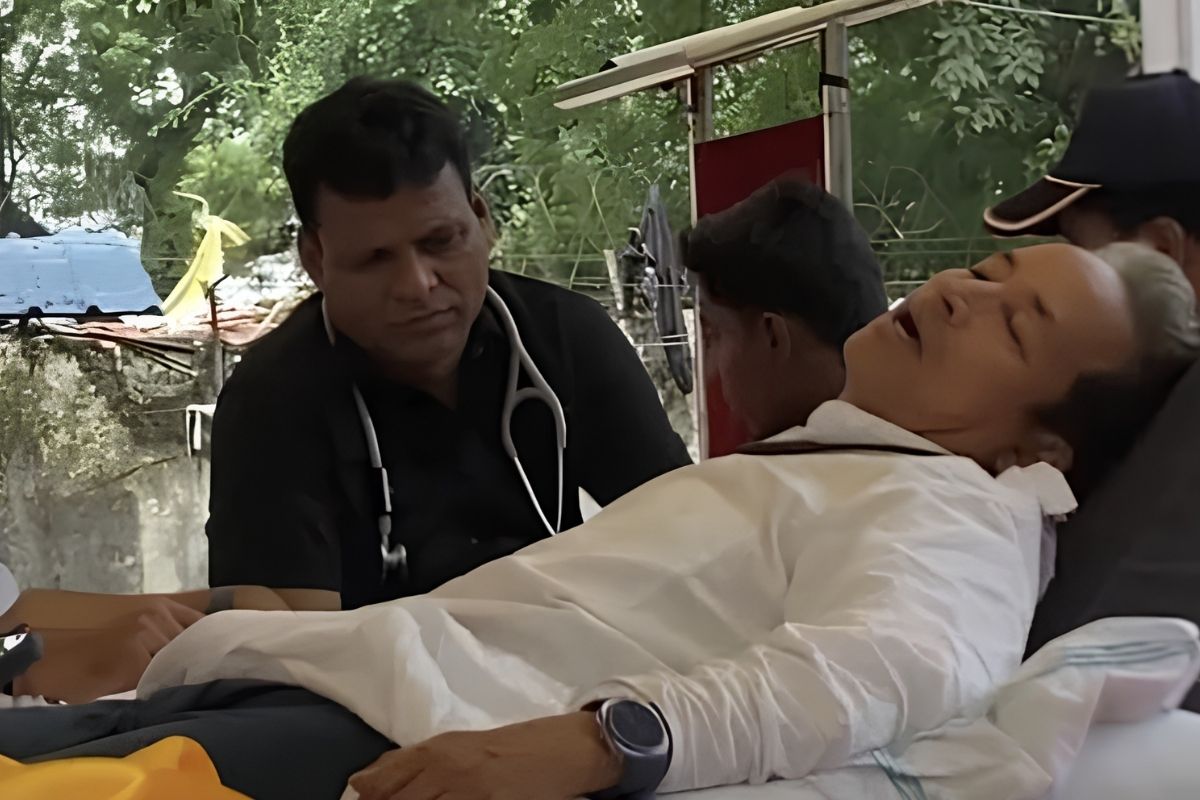
Eighteen days without food. Eight and a half kilograms gone. Blood pressure down to a worrying 109/70. These are the numbers attached to a 59-year-old man sitting at Jantar Mantar in New Delhi, and they are the only numbers anyone can point to with certainty. Everything else — what the government thinks, what it plans to do, whether it plans to do anything at all — remains unknown, because it has said nothing.
Who, What, Why
Sonam Wangchuk — the engineer-turned-activist whose life partly inspired the character Phunsukh Wangdu in 3 Idiots — began an indefinite hunger strike on June 28. He is fasting in solidarity with Abhijeet Dipke, founder of the Cockroach Janta Party (CJP), a satirical, Gen Z-led political movement that describes itself as speaking for “the lazy, the unemployed, and the chronically correct.” Dipke has been staging a sit-in at the same protest site, demanding the resignation of Union Education Minister Dharmendra Pradhan over alleged irregularities in the NEET 2026 examination — irregularities the CJP says are connected to the suicides of students affected by the leaks. Alongside the resignation demand, the group is seeking ₹1 crore in compensation for the affected families.
It is a small, unusual protest by the standards of Indian political spectacle — no major party organized it, no national campaign built up to it — and that may be exactly why it has become one of the country’s most closely watched youth-driven demonstrations in years.
The Silence, Mapped
Strip away commentary and the sequence of events looks like this:
- June 28 — Wangchuk begins his fast at Jantar Mantar.
- Early July — Opposition figures begin weighing in publicly; his health starts to visibly decline.
- July 7–14 — Coverage intensifies as weight loss and falling blood pressure are documented.
- Mid-July — A public interest litigation is filed in the Delhi High Court, asking the central and Delhi governments to intervene medically — including, controversially, to force-feed him.
- July 15 (Day 18) — The Delhi High Court seeks a response from the Centre and Delhi government on that petition. Wangchuk’s condition continues to worsen.
Laid out this way, one column in that timeline stays empty from start to finish: any direct statement, position, or acknowledgment from the education minister, his ministry, or the government’s spokesperson. Reuters reported that requests for comment went unanswered. The absence is not an interpretation — it is a fact you can plot on a calendar, and it does more of the argumentative work than any adjective could.
Why the Modi Government’s Silence?
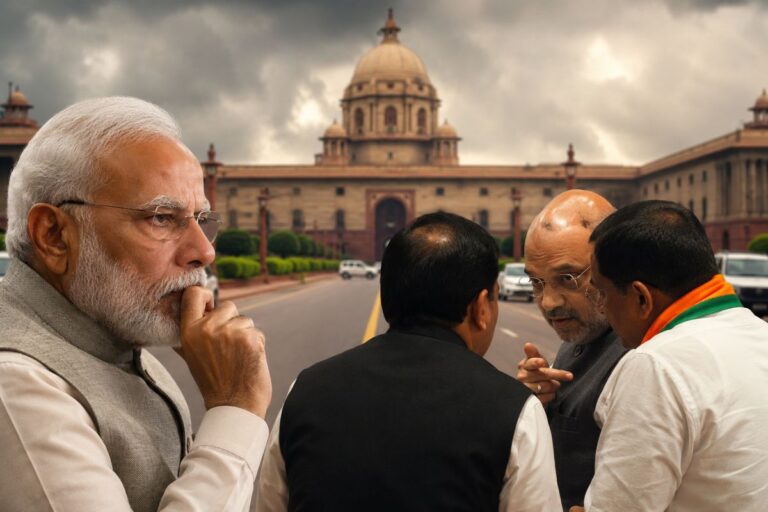
Does the Modi government’s silence suggest that students’ concerns are no longer a priority? That question is growing louder as Sonam Wangchuk continues his hunger strike over alleged examination paper leaks and demands greater accountability in the education system. While millions of students worry about the credibility of competitive exams, the Centre has so far not issued a detailed public response to his demands. For many, the silence has become as significant as the protest itself, fueling debate over whether the government is avoiding a politically sensitive issue or simply choosing not to engage publicly. As the hunger strike continues, the focus is no longer only on Wangchuk’s demands—it is also on why the government has remained largely quiet despite the growing public attention.
The Legal Pressure Point
The Delhi High Court petition forces a question the government has so far avoided answering directly: what happens if nothing changes and Wangchuk’s health continues to deteriorate? The petition, filed by a lawyer, asks the court to direct authorities to hospitalize and force-feed him, arguing that his death would bring international shame on the country and that he is being treated, in effect, like a threat rather than a citizen exercising a protest right.
That framing puts the state in a genuine bind. Medical duty of care is a real obligation; forced intervention in a competent adult’s voluntary fast is a serious infringement with its own troubling precedent for how future protests could be handled. The court has now sought a response from both the Centre and the Delhi government — meaning that, for the first time since June 28, an official reply of some kind is legally on the clock, even if it comes through a courtroom rather than a press briefing.
Also Read: Puri Rath Yatra 2026 Crowd Surge: Two Devotee Dies, Around 100 Rescued During Pahandi Ritual
Who’s Filling the Vacuum
In the absence of a government voice, opposition leaders have stepped into the space. Samajwadi Party’s Akhilesh Yadav described Wangchuk’s life as embodying a commitment to humanity and democracy in equal measure, and urged him to end the fast. Congress MP Shashi Tharoor wrote an open letter making a similar appeal, telling protesters that a fast succeeds once it has stirred the public conscience. Aam Aadmi Party’s Arvind Kejriwal announced plans to visit the protest site in person.
CJP founder Abhijeet Dipke, who has been posting regular health updates on Wangchuk’s condition, put the criticism most bluntly, writing that a government’s failure to respond to a man risking his life for justice reflects not just unaccountability but cruelty. When urged to end his fast, Wangchuk reportedly turned the question back on his critics — suggesting the government, not he, should explain why it won’t listen.
This matters beyond the individual quotes. When the party in power doesn’t narrate its own position, others narrate it for them — and that vacuum has its own political cost, because the story that fills it is rarely a neutral one.
A Global Pattern: How Other Governments Have Responded
Wangchuk’s fast isn’t happening in a vacuum, and neither is the government’s silence. Hunger strikes have long been one of the few protest tools available to people with no institutional power, precisely because they convert personal risk into public pressure — and history shows governments tend to respond in one of a few recurring ways.
- Confrontation, even at fatal cost. The clearest example remains the 1981 Irish hunger strikes, where Bobby Sands and nine other Irish republican prisoners died after the British government under Margaret Thatcher refused to grant their demands for political-prisoner status. Thatcher’s government calculated that conceding would legitimize the prisoners’ cause more than their deaths would damage her government — a bet that arguably backfired, since the strikes hardened support for the republican movement rather than weakening it.
- Negotiated concession under pressure. Cesar Chavez’s fasts in the 1960s and ’80s, protesting farmworker conditions and pesticide exposure in California, eventually drew direct engagement from growers and, at times, political figures including Robert Kennedy, who famously visited Chavez to break one of his fasts. Here, sustained public attention and allied political figures made silence harder to maintain than eventual dialogue.
- India’s own precedent: engagement to defuse. India has its own recent template for this exact dilemma. When anti-corruption activist Anna Hazare fasted in 2011, the government — then under Manmohan Singh — did eventually engage, agreeing to draft anti-corruption legislation partly to bring the fast to an end. That case suggests Indian governments have, before, judged that responding was the lower-cost option once a fast drew sustained national attention enough.
- Managed silence, hoping for fade-out. Aung San Suu Kyi’s hunger strikes and prolonged detentions in Myanmar drew years of official silence and denial from the ruling military government, which calculated that suppression and non-acknowledgment would outlast international attention — a strategy that worked for years before eventually collapsing under sustained global pressure.
What these cases share is a pattern: silence is rarely a neutral default. It is a wager — that the fast will end on its own, that attention will move on, or that a resolution will look weaker than doing nothing. Sometimes that wager pays off. Sometimes, as in 1981 Belfast, it produces exactly the outcome the government hoped to avoid. Where Wangchuk’s fast lands on that spectrum — closer to Hazare’s 2011 resolution or to something more protracted — is still an open question at day 18.
What This Signals
Whatever happens next — a resignation, a court-ordered intervention, or simply the fast continuing until Wangchuk’s body forces an end to it — the more durable story here may not be about one minister or one exam scandal. It’s about what an eighteen-day silence reveals about how the current government chooses to engage with protest movements that sit outside the traditional party system: movements with no national machinery behind them, built instead on social media reach, satire, and a single person’s willingness to put his health on the line.
Silence can be read as strength or as evasion, depending on who’s watching. What it cannot be read as, at day 18, is neutral.
Sources:
- Al Jazeera — Indian activist Wangchuk urged to end hunger strike over exam paper leaks
- Bloomberg — India Activist Sonam Wangchuk Health Worsens in Hunger Strike for Students
- The Week — ‘Sonam Wangchuk’s death could bring great shame’: Petition seeks to force-feed activist on Day 18
- Outlook India — CJP Calls Mass Hunger Strike Tomorrow In Solidarity With Sonam Wangchuk
- The Tribune — Delhi HC seeks Centre, Delhi Govt response on PIL seeking intervention over Wangchuk’s hunger strike
- Bar and Bench — PIL filed before Delhi HC to provide medical aid to Sonam Wangchuk, stop his hunger strike by force feeding
Disclaimer: This article is based on publicly available reports and official proceedings at the time of publication. Any analysis or commentary reflects journalistic interpretation and should not be taken as a statement of fact regarding the intentions or actions of any individual or government authority.