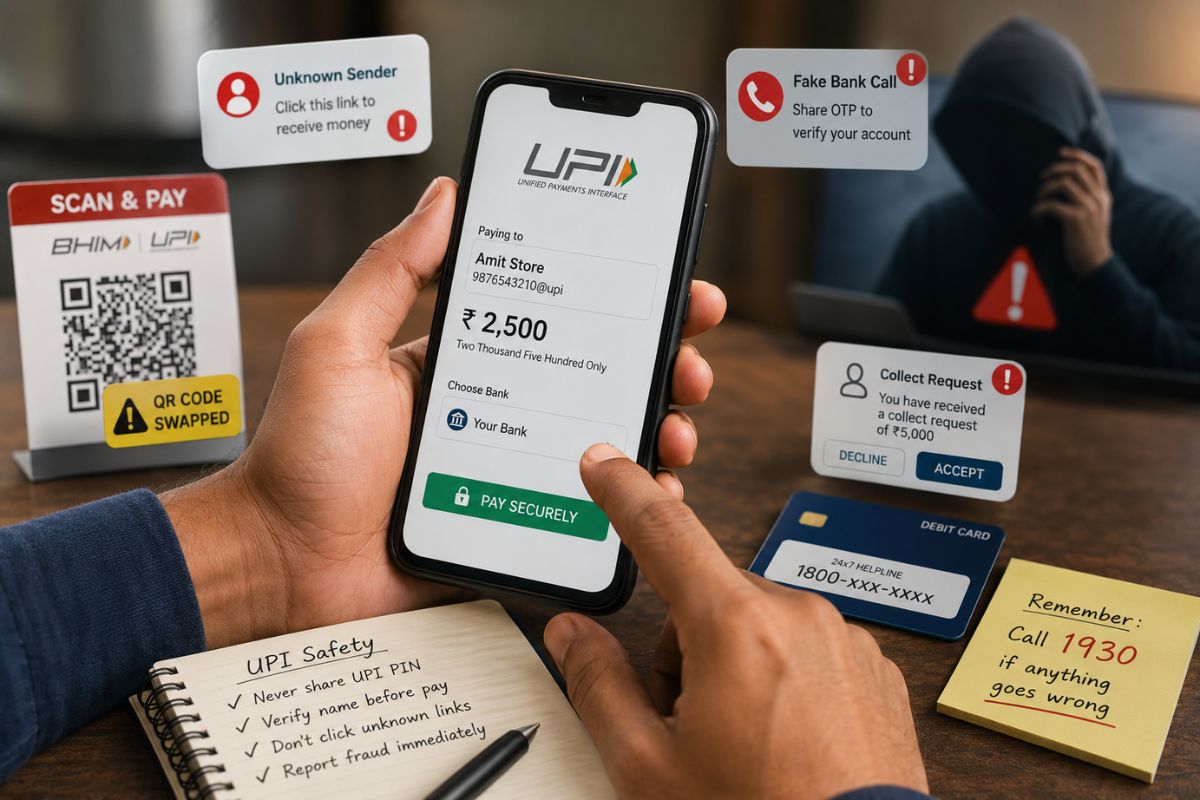
India is running 20 billion UPI payments a month. Sounds bulletproof. But here’s what you don’t see in that number: lakhs of people getting scammed. Fake calls, dodgy QR codes, and payments they hit by accident. This isn’t generic safety advice. It’s built on UPI fraud patterns, actually hitting people in 2026.
The numbers are brutal. UPI fraud hit Rs 981 crore in FY2024-25. That’s across 12.64 lakh cases, according to Lok Sabha data. A LocalCircles survey of 32,000 people found something worse: 1 in 5 families with a UPI user got hit by fraud in three years. And here’s the kicker—51% of victims never bothered reporting it. That silence is why fraudsters keep going.
- Rs 981 crore lost to UPI fraud in FY2024-25 across 12.64 lakh cases (Lok Sabha data, December 2025)
- 1 in 5 Indian families with a UPI user has faced fraud in the past 3 years (LocalCircles, 2025)
- 51% of UPI fraud victims filed no complaint, so real numbers are likely far worse
- UPI crossed 185.8 billion transactions in FY2024-25, a 41.7% jump from the previous year
- Call 1930 the moment you suspect fraud. Speed is the only thing that can save your money
Common UPI Scam Types in 2026
| Scam Type | What Happens | Warning Sign |
| Fake Collect Request | Payment request disguised as an incoming transfer | App asks PIN to “receive” money |
| QR Code Swap | Fake sticker pasted over a real merchant QR | The wrong name appears after the scan |
| Fake Bank Call | Caller asks for OTP or PIN | No real bank ever does this |
| Screen-Sharing Scam | The victim asked to install AnyDesk or TeamViewer | Any “agent” asking to install remote apps |
| SIM Swap | Fraudster reissues your SIM to steal OTPs | Sudden and complete loss of signal |
| Fake Customer Care | Fake helpline numbers ranking on Google | Number sourced from a search result |
Also Read: Here’s How to Apply for a Passport Online in India
15 UPI Safety Rules That Could Save Your Money
- Never share your UPI PIN. No bank, no NPCI official, nobody has a reason to ask for it. If anyone does, hang up.
- You never enter a PIN to receive money. When money comes to you on UPI, you do nothing. If a screen asks for your PIN to receive a payment, you are about to send money out. Cancel immediately.
- Read the merchant name before you pay. After scanning any QR code, check whose account the money is going to. Fraudsters stick fake QR codes over real ones at petrol pumps and small shops. If the name does not match, do not pay.
- Never install an app a caller recommends. Remote access tools like AnyDesk or Quick Support hand over your screen to whoever is on the other end. NPCI put out a specific advisory warning about this in March 2026. No bank will ever ask you to install one.
- Get your bank helpline number from your debit card, not Google. The I4C removed over 4,200 fake customer care pages from search results in early 2026. New ones keep going up. Your bank’s real number is printed on the back of your card.
- Set up a biometric lock on your UPI app today. Takes two minutes. Protects your account even if your phone is stolen.
- Never click links sent over WhatsApp or SMS to receive money. Real UPI transfers do not require you to open any link. A LocalCircles survey found 40% of fraud victims were tricked exactly this way.
- Lower your daily UPI transaction limit. If you spend under Rs 5,000 a day, why keep the limit at Rs 1 lakh? Reduce it inside your bank’s app to cap your worst-case loss.
- Keep your UPI app updated. Outdated apps carry known security gaps. Turn on auto-updates and stop putting it off.
- Review your transaction history every week. Fraud caught early can sometimes be reversed. Fraud found weeks later usually cannot.
- Report within 30 minutes if something goes wrong. Call 1930, file at cybercrime.gov.in, and call your bank on the same day. The RBI zero-liability policy gives you a window of 3 days to qualify for a refund, but the sooner you act, the better.
- Never make payments on public Wi-Fi. Use your mobile data instead. Open networks at cafes and airports can be monitored.
- If your phone loses signal suddenly, act fast. It could be a SIM swap in progress. Call your telecom provider immediately from another phone.
- Nobody charges you to verify your account. A “Rs 1 verification payment” is fraud. It links your UPI to another device. Refuse it.
- Explain all of this to your parents. Senior citizens lost over Rs 2,000 crore to impersonation scams in 2024, according to government data. One conversation with your family is worth more than any security setting.
Also Read: Government Exams With the Best Salary Packages in India
What to Do If You Are Defrauded?
Call 1930 immediately. File a complaint at cybercrime.gov.in. Inform your bank. Report through your UPI app. Visit your nearest police station for an FIR. Do everything on the same day.
UPI fraud rarely looks dramatic. It comes disguised as a helpful phone call, a routine notification, or a tiny payment to unlock something. Recognising these situations for what they are is your strongest protection. Go through these 15 rules, set up what you have not yet done, and share this with someone in your family who needs it.
Sources and References
- Rs 805 Crore Lost to UPI Frauds This Year, Government Says
- 1 in 5 Families Experienced UPI Fraud Once or More in the Last 3 Years
- How Digital Scams Hit Your Wallet in 2025 and Lessons for 2026 to Avoid Them
- 1 in 5 UPI Users Faced Fraud; 51% Victims Did Not Report, Reveals Survey
- NPCI UPI Product Statistics and Transaction Limits
- Top UPI Fraud Trends in India 2026
- RBI Customer Protection in Unauthorised Electronic Banking Transactions
- National Cyber Crime Reporting Portal, Ministry of Home Affairs
- Online Fraud in India: 2025 Projections and Analysis