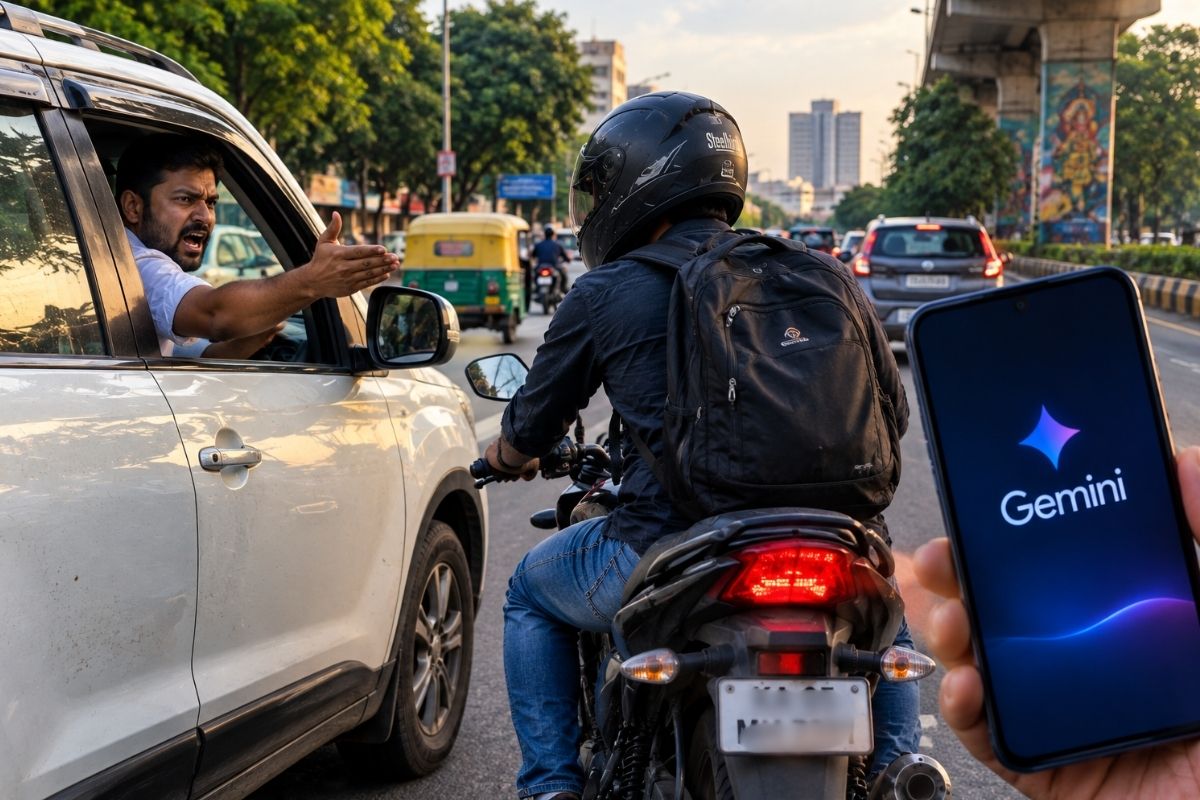
A Bengaluru road-rage incident has taken an unexpected AI twist after startup CEO Siddharth Dialani said Google’s Gemini helped him draft a police complaint and figure out how to document the dispute. The case ended with the biker apologizing and paying for the damage to Dialani’s car, according to his account.
The story has drawn attention in the United States and elsewhere because it combines generative AI, dashcams and digital evidence — three technologies that keep showing up together.
The outcome wasn’t simply a chatbot solving a road-rage dispute. The evidence and the police response drove what happened next.
- Bengaluru CEO Siddharth Dialani said Gemini helped him prepare a police complaint.
- The incident happened between Sony Signal and Ejipura Signal.
- Dialani’s dashcam captured the confrontation.
- Police used the vehicle information visible in the footage to identify the biker.
- The biker apologized in writing and paid for the vehicle damage, according to Dialani.
What Happened in the Bengaluru Road-Rage Incident?
According to Siddharth Dialani account, a biker traveling with his wife believed the CEO’s car had brushed against his motorcycle.
The confrontation escalated after the biker stopped Dialani’s car. Dialani said the man kicked the side of the vehicle, rammed the car from behind, then repeatedly overtook him and braked in front of the vehicle.
The incident took place between Sony Signal and Ejipura Signal in Bengaluru.
Dialani said he first considered letting the matter go, then saw the damage to his car and decided to report it. His dashcam had recorded the whole thing.
How Gemini Entered the Story
Dialani didn’t write the complaint entirely on his own. He said he used Google Gemini to help draft a formal complaint for the Koramangala police station.
Gemini also suggested he get a written acknowledgment after submitting the complaint. Dialani followed that advice: he stayed at the station until he had confirmation the complaint had been submitted.
Gemini didn’t identify the alleged offender or establish what happened. Those steps depended on the dashcam footage, the vehicle registration information and police follow-up.
Also Read: Oracle Layoffs 2026: Latest News, Job Cuts, Reasons and What Happens Next
Dashcam Footage Helped Police Identify the Biker
Dialani gave police the dashcam footage and photographs.
The footage showed the biker’s registration number. Police used that information to identify the rider and pull a phone number from their database, according to Dialani’s account.
Officers called the biker to the station.
Dialani said the biker disputed responsibility at first. Once he saw the photographs and heard about the possibility of an FIR and criminal proceedings, he changed course, and the dispute was resolved.
What Happened to the Biker?
Dialani said the biker wrote an apology and paid for the damage to the car.
Dialani also praised the Koramangala police for how they handled the matter and said the dispute was resolved without a bribe. These details come from Dialani’s own social-media account and have been repeated by multiple news outlets. They’re his account, not independently confirmed findings.
He closed his post with a line that stuck: “Gemini is my lawyer now.”
That phrase became the most quoted part of the story.
Does This Mean Gemini Can Replace a Lawyer?
No.
The Bengaluru case shows one use of generative AI: helping someone organize information and turn an account of an incident into a formal document.
AI-generated legal or police complaints still need a human to check them. An AI system can get facts wrong, produce inaccurate legal language, or suggest steps that don’t apply in a given jurisdiction.
The strongest evidence here wasn’t the chatbot. It was the documented incident: the dashcam footage, the photographs, the formal complaint, and the police action, working together.
That distinction matters as more people turn to AI for legal correspondence and everyday disputes.
Also Read: New UPI Charges On Payment Explained: Rules, Limits And MDR Rate (2026)
Why the Story Is Going Viral
The incident struck a chord because it pairs a familiar problem with a modern solution.
Road rage is a real-world confrontation. A dashcam creates a digital record. Gemini helped prepare the paperwork. Police then used the available evidence to trace the other party. Together, this shows how AI can act as a first-draft assistant for ordinary administrative problems, without replacing lawyers, investigators or government officials.
The story has also sparked online discussion about whether dashcams should become more common and whether AI tools could make bureaucratic processes easier for people.
For now, the Bengaluru case remains a personal account shared by Dialani. But it’s a useful look at how AI-assisted documentation and conventional evidence can work together when someone needs to report a dispute.
FAQs
Who is Siddharth Dialani?
Siddharth Dialani is the founder and CEO of BharatAgri, an agritech company. He shared the Bengaluru road-rage incident on X in September 2026.
How did Gemini help the Bengaluru CEO?
Dialani said Gemini helped him draft a formal complaint for the Koramangala police station and advised him to get written acknowledgment of the complaint.
Where did the Bengaluru road-rage incident happen?
Dialani said the confrontation happened between Sony Signal and Ejipura Signal in Bengaluru.
How was the biker identified?
Dialani’s dashcam captured the biker’s vehicle registration number. Police used that information to identify and contact the rider.
Did the biker apologize and pay for the damage?
Yes. According to Dialani, the biker eventually wrote an apology and paid compensation for the damage to the car.
Source
- Livemint: ‘They fed me samosa’: Bengaluru CEO uses Gemini, dashcam to outsmart a road rage biker
- Hindustan Times: Bengaluru CEO says Gemini helped after biker hit his car: ‘My lawyer now’
- Money Control: ‘Gemini is my lawyer now’: Bengaluru CEO shares how AI helped resolve road rage case