Here’s the short version: regular folks sending money to friends or paying for everyday stuff pay nothing. Zero. But there’s a new twist. A 0.4% Merchant Discount Rate (MDR) kicks in for bigger business sales. That starts 15 October 2026.
The new UPI charges on payment rule locks in something important. Consumer transfers stay free. So do merchant payments up to ₹2,000, forever, apparently. Above that? Commercial transactions face a fee, capped at 0.4%, maxing out at ₹300. And here’s the thing: the business pays it, not you.
- Everyday Users Pay ₹0: P2P transfers and small purchases up to ₹2,000 stay free. No catch.
- The 0.4% Business Levy: Merchants taking payments above ₹2,000 via QR or checkout pay 0.4% MDR. Capped at ₹300.
- Micro-Merchants Exempt: Small shops under ₹1 lakh a month in UPI QR volume pay nothing. That’s the P2PM category.
- Legal Shield: Gazette Notification S.O. 5067(E) backs this up legally. Low-value digital payments stay free, by law.
- Merchants Cannot Surcharge: Stores can’t just tack a “UPI surcharge” onto your bill. That’s illegal, plain and simple.
The Key UPI Facts Everyone Must Know
On September 14, 2026, the Ministry of Finance dropped Gazette Notification S.O. 5067(E). It’s under Section 10A of the Payment and Settlement Systems Act, 2007. What it does, essentially, is protect all P2P transfers and P2M payments up to ₹2,000 from fees. Direct or indirect, doesn’t matter.
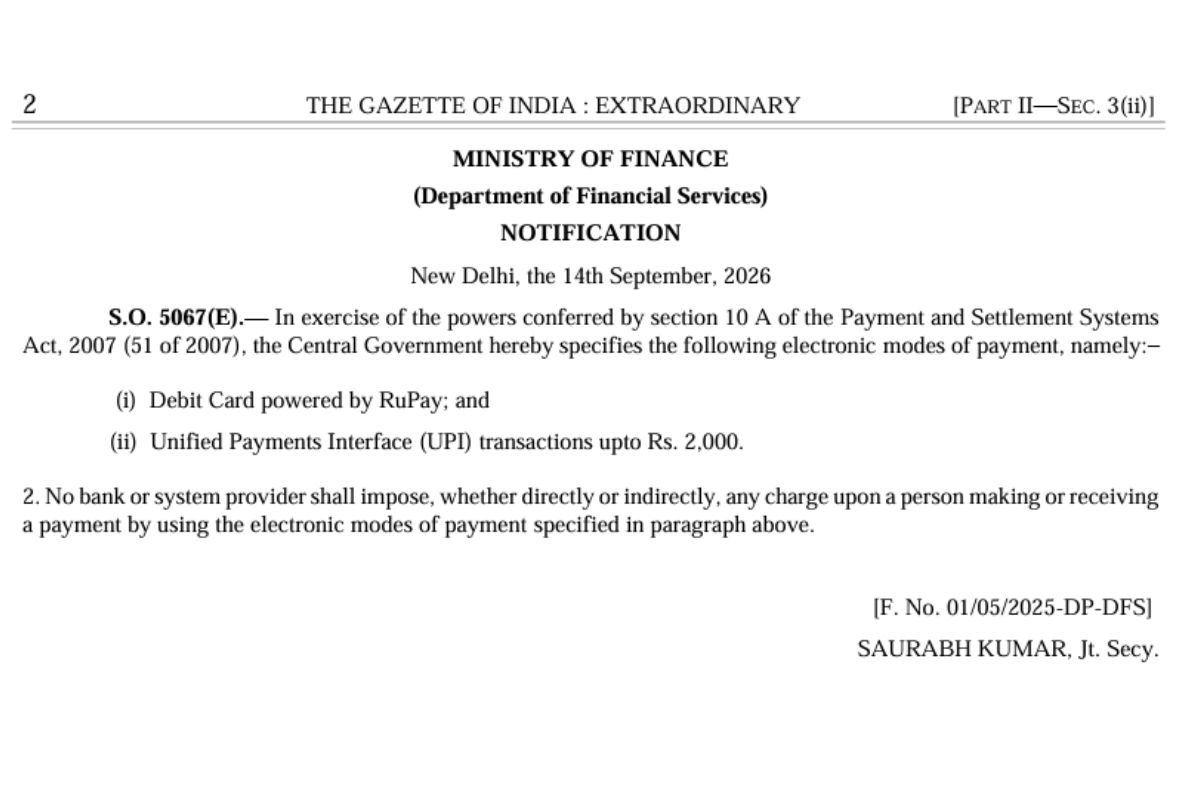
To handle the bigger commercial stuff, NPCI rolled out a revised MDR framework. From 15 October 2026, P2M transactions above ₹2,000 get hit with 0.4% MDR. There’s a cap though. High-value sales top out at ₹300, once you cross ₹75,000.
Also Read: The Real Timeline For RBI’s Polymer Notes Trial in India: Paper vs Plastic Currency
Roughly 96% of everyday UPI checkouts stay completely free. That’s honestly a pretty large share, when you think about it. Only about 4% of merchant payments actually get touched by this. NPCI’s Steering Committee decided the levy, and businesses pay it. Not a consumer tax, not even close.
| Transaction Value | Fee Rate | Fee Amount Paid by Merchant | Source |
|---|---|---|---|
| Up to ₹2,000 | 0% (Free) | ₹0 | Gazette S.O. 5067(E) |
| ₹5,000 | 0.4% | ₹20 | NPCI MDR Framework |
| ₹10,000 | 0.4% | ₹40 | NPCI MDR Framework |
| ₹75,000+ | 0.4% (Capped) | ₹300 Max | NPCI MDR Framework |
Table Source: Data compiled from official notifications by the National Payments Corporation of India (NPCI) (MDR Framework) and the Ministry of Finance, Government of India (Gazette Notification S.O. 5067(E)).
The 2020 History Lesson: Why Zero-MDR Ran Out Of Cash
Back in January 2020, the government scrapped MDR on RuPay debit cards and UPI. The goal was simple: get everyone onto digital payments, fast. For six years after that, the Finance Ministry covered payment aggregators and banks through subsidy pools. Usually somewhere between ₹1,500 and ₹2,000 crore a year.
But then volumes exploded. We’re talking 24.51 billion transactions in a single month, that’s August 2026. Processing millions of hits per second isn’t cheap. Server costs, fraud detection, cybersecurity – it all adds up. Taxpayer subsidies couldn’t keep pace forever, let’s be real. Bringing back a light MDR shifts the cost burden. Off government budgets, onto business revenue instead.
Where Does The 0.4% Fee Actually Go?
Say a merchant processes ₹5,000 and pays ₹20 in MDR. Where does that money end up? It gets split across the payment chain.
- Issuing Bank (~45%): Your bank, the one holding your money (SBI, HDFC, whoever). Gets the biggest slice. Covers fraud liability, core banking systems, keeping servers up and running.
- Acquiring Bank / App (~45%): The app running the merchant’s QR code or POS terminal, think Paytm, PhonePe, Razorpay. Pays for onboarding merchants and handling customer support.
- NPCI Core Network (~5%): A system switch fee. Keeps transactions routing safely.
- Financial Inclusion Fund (5%): Goes straight toward rural payment infrastructure. And digital literacy programs too.
The Uncovered Cost: 18% GST On The MDR
Here’s something a lot of people miss: there’s a hidden second cost. GST.
Merchant processing counts as a financial service, legally speaking. So payment aggregators have to slap 18% GST on top of whatever MDR they collect.
Transaction Value: ₹10,000
Base 0.4% MDR Fee: ₹40.00
18% GST on Fee: ₹7.20
Total Merchant Cost: ₹47.20 (Effective rate ~0.472%)
If you’re a registered company, you can claim this back through Input Tax Credit. Fine, no real loss there. But small, unregistered traders? They’re stuck. The real processing cost creeps up toward 0.47% for them, which isn’t nothing.
Will Merchants Try To Bypass The Rule?
Since the 0.4% only kicks in above ₹2,000, some shops might get creative at the till.
- Bill Splitting: Buying ₹3,200 worth of stuff? The cashier might ask for two separate scans of ₹1,600 each. Keeps both under the free threshold.
- Cash Nudges for Large Bills: Electronics stores, jewellers, furniture shops, they might offer a small cash discount instead. Dodges the ₹300 cap fee on big-ticket sales.
- RuPay Credit-on-UPI Shift: Some merchants might push buyers toward credit rail alternatives, where the fee structure already exists anyway.
UPI Vs. Cards And Global Real-Time Payments
Even with this new fee, UPI’s still cheap. Oddly enough, it remains one of the most affordable digital payment systems anywhere in the world.
| Payment Rails | Consumer Fee | Merchant MDR Rate |
|---|---|---|
| UPI (New 2026 Rule) | ₹0 (Free) | 0.4% (Cap ₹300) |
| Credit Cards (Visa / Mastercard) | ₹0 | 1.8% – 2.5% |
| Debit Cards (Non-RuPay) | ₹0 | 0.9% |
| Brazil (Pix System) | ₹0 | ~0.33% |
| China (Alipay / WeChat Pay) | ₹0 | ~0.40% |
Table Source: Compiled from official regulatory notifications by the National Payments Corporation of India (NPCI), Reserve Bank of India (RBI), Banco Central do Brasil, and People’s Bank of China (PBoC) merchant interchange guidelines (2026).
The Industry Clash: Ashneer Grover Vs. Fintech Founders
Naturally, this split fintech leaders right down the middle.
- The Opposing Side: BharatPe’s Ashneer Grover isn’t buying it. He points out NPCI’s sitting on ₹6,119 crore in cash reserves and posted a ₹1,900 crore pre-tax profit last year. His argument? NPCI’s got plenty of cushion to keep UPI free; no government help needed.
- The Supporting Side: PhonePe’s Sameer Nigam, Paytm’s Vijay Shekhar Sharma, and MobiKwik’s Upasana Taku see it differently. They argue that keeping security tight across 24+ billion monthly transactions needs real money. Not just goodwill.
What Traders’ Associations Are Saying
Trade bodies, CAIT among them, aren’t thrilled either. Their worry is that charging businesses for accepting digital payments works against the whole “Digital India” push. Small retailers already run on thin margins, 2-3% typically. Force fees on top of that, and some might just go back to cash. It’s a fair concern, honestly.
What Could Change Before 15 October 2026?
There’s a four-week gap between the notification and the rollout. Plenty of time for lobbying to shift the details.
- Sectoral Exemptions: Petrol pumps, government utilities, schools, they’re all pushing for carve-outs or lower caps.
- Higher P2PM Thresholds: Trade groups want the micro-merchant ceiling raised. From ₹1 lakh a month up to ₹2.5 lakh.
Broking Models: The ₹15,000–₹20,600 Crore Revenue Pool
Brokerages reckon this fee could pull in somewhere between ₹15,000 crore and ₹20,600 crore annually. That’s a big number, and it’s flowing straight into banking and fintech.
Estimated P2M Monthly UPI Volume: ~12 Billion Transactions
Percentage Over ₹2,000: ~4% (480 Million Transactions)
Average Ticket Size of Eligible Sales: ~₹8,000
Total Fee Base Processed: ~₹3.84 Lakh Crore / month
0.4% MDR Levy Yield: ~₹1,536 Crore / month (~₹18,432 Crore annually)
Citi’s analysts think Paytm alone could grab ₹300 crore from MDR revenue share directly. Plus another ₹600–700 crore from acquiring business growth every year.
Also Read: Global Fintech Fest 2026: The World’s Premier Gathering Shaping Future Finance
Frequently Asked Questions
Will I Be Charged For Sending Money Via UPI To My Friends Or Family?
No. P2P transfers stay 100% free. Doesn’t matter how much you send.
Will Local Grocery Stores Charge Me 0.4% Extra At The Checkout Counter?
No. NPCI and the Finance Ministry ban merchants from adding surcharges.
Does The New 0.4% Charge Apply To Payments Under ₹2,000?
No. Under Gazette Notification S.O. 5067(E), payments up to ₹2,000 stay free.
Do Small Tea Stalls And Kirana Shop Owners Have To Pay This MDR?
No. Micro-merchants under ₹1 lakh a month via UPI QR fall under P2PM. They pay 0% MDR.
When Do These New UPI Payment Charges Start?
The revised framework rolls out across India from 15 October 2026.
Sources
- Ministry of Finance (Department of Financial Services) (14 Sept 2026): Gazette Notification S.O. 5067(E) issued under Section 10A of the Payment and Settlement Systems Act, 2007.
- National Payments Corporation of India (NPCI) (15 Sept 2026): Circular on Revised UPI MDR Framework & Cap Limits for P2M Transactions.
- Goldman Sachs & Citi Research (Sept 2026): Equity Research Reports on Digital Payments Sector & Revenue Estimates.
Disclaimer: The information provided in this article regarding financial policies, Merchant Discount Rate (MDR) regulations, and UPI transaction charges is strictly for informational purposes only and not for promotion or commercial endorsement. Readers should not rely on this content as formal financial, tax, or legal advice. Readers are strongly advised to verify all facts independently with official government notifications or certified professionals before making financial decisions, as these may vary over time.