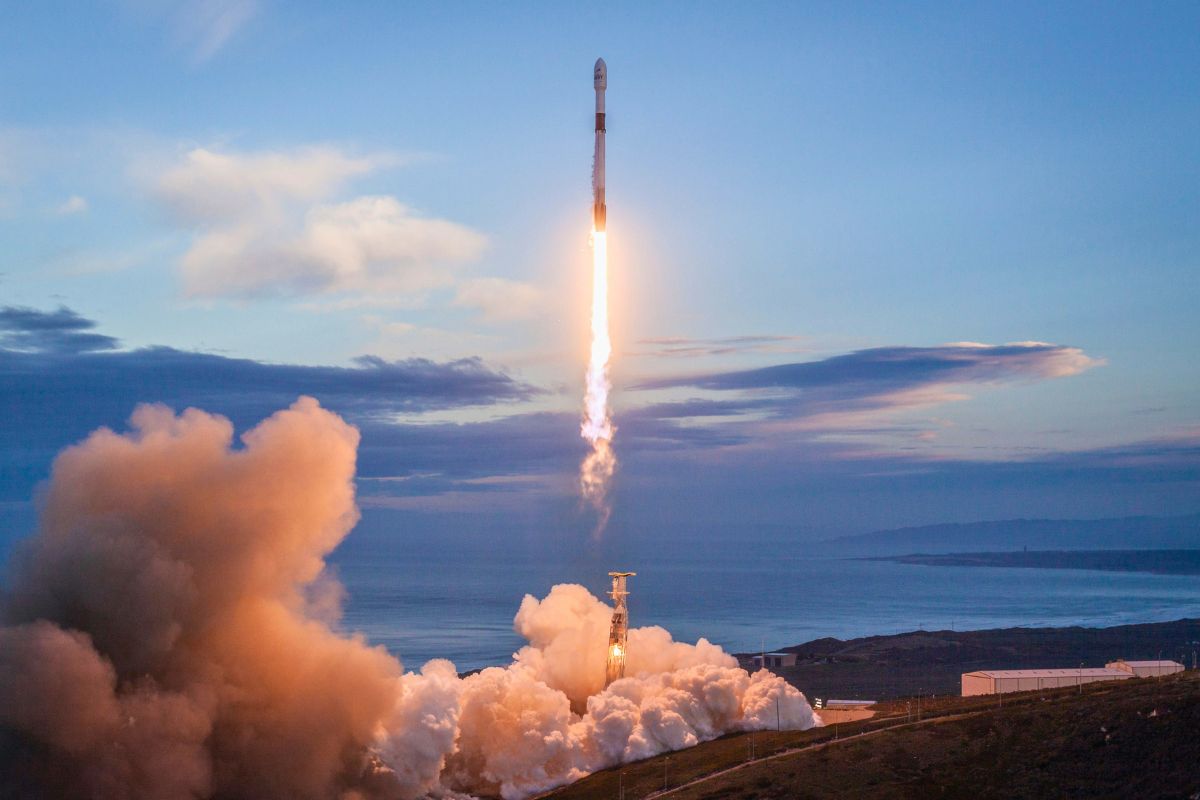
Six years ago, launching a rocket in India meant working for the government, full stop. Today, a Hyderabad-based space startup founded by two ex-ISRO scientists has put a privately built rocket into orbit, become the country’s first space-tech unicorn, and struck a partnership with a drone-maker to build unmanned military systems — all inside the same eighteen months.
- Policy, not permission, drives the boom. ISRO is actively transferring flight-proven rocket IP (SSLV, and soon part of PSLV) to private industry, not just “allowing” private players in.
- Space and defence are converging. Companies like Digantara and Skyroot are moving fluidly between satellite work and missile-tracking or drone-defence investments.
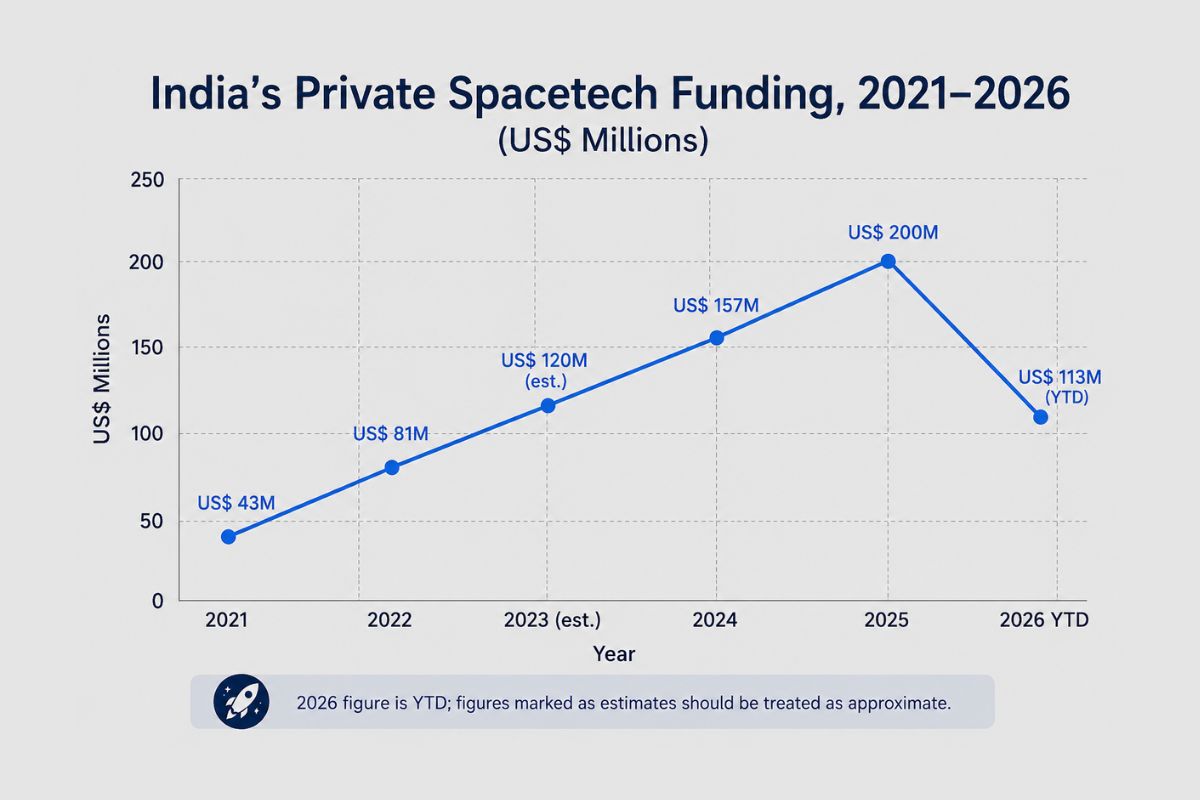
- Funding has grown fivefold since 2021 — from $43 million to a $200 million annual record in 2025 — but remains concentrated in a handful of companies.
- India trails China and the US by a wide margin on capital, yet is only the third country with a privately built rocket to reach orbit.
- The next two years bring concrete catalysts: a second Vikram test flight, PSLV’s private handover, and possibly India’s first spacetech IPO.
That last part matters as much as the rocket. India’s space start-up story is no longer only about satellites and launch vehicles. It’s increasingly about a single, converging idea: dual-use technology, where the sensor that watches a crop field can also watch a border. This article explains how India got here, who’s building what, and where the sector — and the money behind it — is heading next.
Why India’s Space Sector Is Opening Up
For six decades, Indian space activity meant one organisation: ISRO. That changed in June 2020, when the government created the Indian National Space Promotion and Authorisation Centre (IN-SPACe) as a single-window regulator sitting between ISRO and private industry. The Indian Space Policy 2023 then formally defined roles for ISRO (research), NSIL (commercialisation) and IN-SPACe (authorisation), inviting non-government entities to carry out end-to-end space activities.
The FDI rules that followed in 2024 split the sector into three risk tiers rather than a blanket cap. According to the Prime Minister’s Office, satellite manufacturing permits up to 74% automatic FDI, launch vehicles and spaceports are capped at 49% automatic, and component manufacturing is fully open to 100% FDI — channelling foreign capital toward the commodity layer while keeping tighter oversight over anything that overlaps with defence.
More significant still is technology transfer. In September 2025, NSIL, ISRO, IN-SPACe and Hindustan Aeronautics Limited (HAL) signed an agreement worth roughly ₹511 crore handing HAL the complete Small Satellite Launch Vehicle (SSLV) design — the first time any space agency has transferred a full launch-vehicle design to private industry, according to ETV Bharat.
ISRO is now moving to offload up to half of PSLV production too, per The Week. NSIL has executed 118 technology transfer agreements covering 83 ISRO technologies in total.
| Year | Reform | What it did |
|---|---|---|
| 2020 | IN-SPACe created | Single-window authorisation for private space activity |
| 2023 | Indian Space Policy notified | Defined ISRO/NSIL/IN-SPACe roles; invited private participation |
| 2024 | FDI norms liberalised | Up to 100% FDI in components; 74% satellites; 49% launch vehicles |
| 2025 | SSLV transferred to HAL | First full launch-vehicle handover by any space agency |
| 2025–26 | PSLV transfer under way | Up to 50% of production moving to industry |
Table Source: PIB/PMO
Satellite Startups Leading The Charge
- Pixxel, India’s best-known space-tech name internationally, builds hyperspectral Earth-observation satellites. It has raised roughly $98 million, according to Inc42, backed by Google and Lightspeed, and has separately taken Ministry of Defence iDEX grants for Air Force payload work.
- Dhruva Space, founded in 2012, is one of India’s oldest space companies, offering full-stack satellite platforms, launch integration and ground stations, having raised roughly $28–31 million per Officechai.
- SatSure turns Earth-observation data into “decision intelligence” for banks and insurers assessing crop-backed loans, per DefenceXP — proof that not every space start-up needs to build hardware.
- Digantara began tracking orbital debris and has since expanded into missile-tracking and space-based defence, raising a $50 million Series B in December 2025 (total funding $64.5 million), according to TechCrunch — one of the clearest dual-use pivots in the sector.
- Bellatrix Aerospace builds satellite propulsion systems and has raised around $31 million to date, per Inc42.
Also Read: Why The UN Approved A New World Map: A Fair World Begins With A Fair Map
Drones And UAV Startups
India relaxed drone regulations in 2021, well ahead of most space-tech reforms, opening up civil and defence use cases together. ideaForge is the standout: built after the 2008 Mumbai attacks exposed a surveillance gap, it now commands roughly 50% of the domestic drone market, according to a peer-reviewed case study, and listed in 2023 via a ₹567 crore IPO subscribed 50 times over, per The Ken.
In November 2025, the Indian Army placed roughly ₹100 crore in emergency orders for its ZOLT and SWITCH 2 systems after electronic-warfare trials, according to The Defense Post. Defence still supplies the majority of its revenue — 57% in one recent quarter, per CB Insights — a reliable but concentrated customer base.
A wider ecosystem of smaller drone start-ups has grown around the 2021 reforms and the government’s PLI scheme, though most remain dependent on state contracts rather than open commercial demand.
The Convergence: Space-Linked Defence Tech
The boundary between “space start-up” and “defence start-up” is dissolving. Digantara now sells missile-tracking capability to governments; Pixxel takes iDEX grants for Air Force payloads; and in May 2026, rocket-maker Skyroot Aerospace invested directly in Apollyon Dynamics, a defence-drone developer, according to StartupTalky.
The logic is straightforward: a crop-monitoring sensor can just as easily watch troop movement, and a satellite thruster and a reconnaissance thruster share the same underlying technology.
Investors have followed — 360 ONE Asset raised a ₹1,000 crore defence-and-space fund, and SIDBI closed a ₹1,005 crore Antariksh Venture Capital Fund in November 2025, according to Inc42, both built on the assumption that space and defence capital will flow to the same companies.
Funding Trends
India’s private spacetech sector had raised roughly $871 million across 241 rounds and 285 companies as of July 2026, according to Tracxn/Business Standard. Annual funding grew roughly fivefold in four years, from $43 million (2021) to a record $200 million across 53 rounds in 2025, with $113 million more by mid-2026.
Five rounds — Skyroot, Digantara, EtherealX, Bellatrix and AgniKul Cosmos — together accounted for $158 million, over half of all 2025–26 capital, and the top 10 funded startups hold more than 60% of total sector funding.
Seed funding rose from $7 million (2022) to $62 million (2025), while late-stage funding, absent until 2025, reached $53 million by mid-2026 — signs of a maturing, if narrow, market. Only 72 of 285 tracked startups had raised any equity funding at all as of mid-2026, per the same source.
Source: Tracxn/Business Standard.
Government Support
- Launch access: the SSLV offers a stated 72-hour, on-demand turnaround, per NSIL material via Grokipedia, giving small-satellite firms a domestic alternative to SpaceX or European launchers.
- Grants: the Ministry of Defence’s iDEX programme funds space-adjacent projects, including Pixxel’s Air Force payload work, effectively acting as early-stage capital.
- PPP vehicles: state-anchored funds like the ₹1,005 crore Antariksh VC Fund co-invest alongside private VCs to lower the capital barrier for deep-tech founders.
Between 2015 and 2024, India’s commercial launch services carried 393 foreign satellites and earned close to $439 million in foreign exchange, according to IMARC Engineering — the commercial logic behind scaling up private launch capacity.
Also Read: Donald Trump Economic War Against Iran Hits 4 Indian Firms As Sanctions
Challenges
- Capital intensity: hardware takes years and tens of millions of dollars to reach flight-readiness with no interim revenue — why three-quarters of startups have never closed an institutional round.
- Regulatory gaps: liability, indemnification and space-object registration rules remain unsettled in subordinate regulation, per a ScienceDirect analysis.
- Customer concentration: firms like ideaForge depend heavily on government and defence procurement.
- Global competition: India is scaling from a low base against far larger rivals (see below).
India Vs The World
In 2024, China surpassed the US in VC/PE space-tech funding for the first time — roughly $2.7 billion versus $2.6 billion, according to Space Ambition. Chinese spacetech firms raised over $799 million in just the first ten months of 2025, per Tracxn — over four times India’s entire 2025 total — with 60–70% of that now coming directly from the state.
The US remains in its own category: SpaceX’s 2026 IPO raised $75 billion, the largest tech IPO in history, at a near-$1.8 trillion valuation, according to Reuters, with 2025 revenue of nearly $19 billion.
Against that, India’s $200 million 2025 record looks modest — but India became just the third country, after the US and China, to achieve a privately developed orbital launch, with Skyroot’s Vikram-1 mission in July 2026, per BW Disrupt — a tier only two other nations occupy, thanks largely to ISRO’s decades of flight heritage. The EU, by comparison, has struggled with its own launch ambitions amid repeated Ariane 6 delays.
Where The Sector Is Headed
The FICCI-EY report targets growth from $8.4 billion (2022) to $44 billion by 2033, lifting India’s global share from 2–3% to 8%, according to FICCI — a projection, not a guarantee.
Near-term catalysts include a second Vikram test flight in 2026 ahead of commercial launches from 2027, plus Gaganyaan, Chandrayaan-4 (2027), Shukrayaan (2028) and the Bharatiya Antariksh Station (~2030), per News on Air. Watch also for further PSLV transfer progress and, plausibly, India’s first spacetech IPO within two to three years.
Also Read: Pilot Jobs in India 2026: Current Opportunities, Eligibility, Salary, Airlines & How to Get Hired
Frequently Asked Questions
Is India’s Space Sector Open to Foreign Investors?
Yes — up to 100% FDI in components, 74% in satellites, 49% in launch vehicles, per the PMO.
What is IN-SPACe?
India’s single-window regulator for private space activity, created in 2020, working alongside NSIL and ISRO.
Which is India’s Most Valuable Space Startup?
Skyroot Aerospace, valued above $1.1 billion after its May 2026 Series C, per StartupTalky.
How Much Have Indian Space Startups Raised in Total?
Roughly $871 million across 241 rounds as of July 2026, per Tracxn/Business Standard.
Are Drone and Defence-tech Startups Linked to Space?
Increasingly — Digantara, Pixxel and Skyroot all straddle both, a pattern called “dual-use convergence.”
The Takeaway
India’s space sector isn’t catching up to global leaders on funding — not yet. What it has done is convert six decades of ISRO’s flight heritage into a private-sector head start, paired with a policy architecture designed to turn that heritage into commercial products quickly.
The most interesting story from here isn’t the next big round; it’s how thoroughly satellite, drone and defence-tech start-ups keep blurring into each other — a convergence that will decide whether India reaches the $44 billion its government is banking on by 2033.
Disclaimer: This article is published strictly for general educational and informational purposes and does not constitute technical, legal, financial, or investment advice, nor should it be construed as promotional material for any entity or technology. While efforts have been made to present accurate data, deep-tech market evaluations and regulatory policies are subject to rapid change. Readers must independently verify all facts and consult qualified professional advisors prior to taking any actions based on this content.