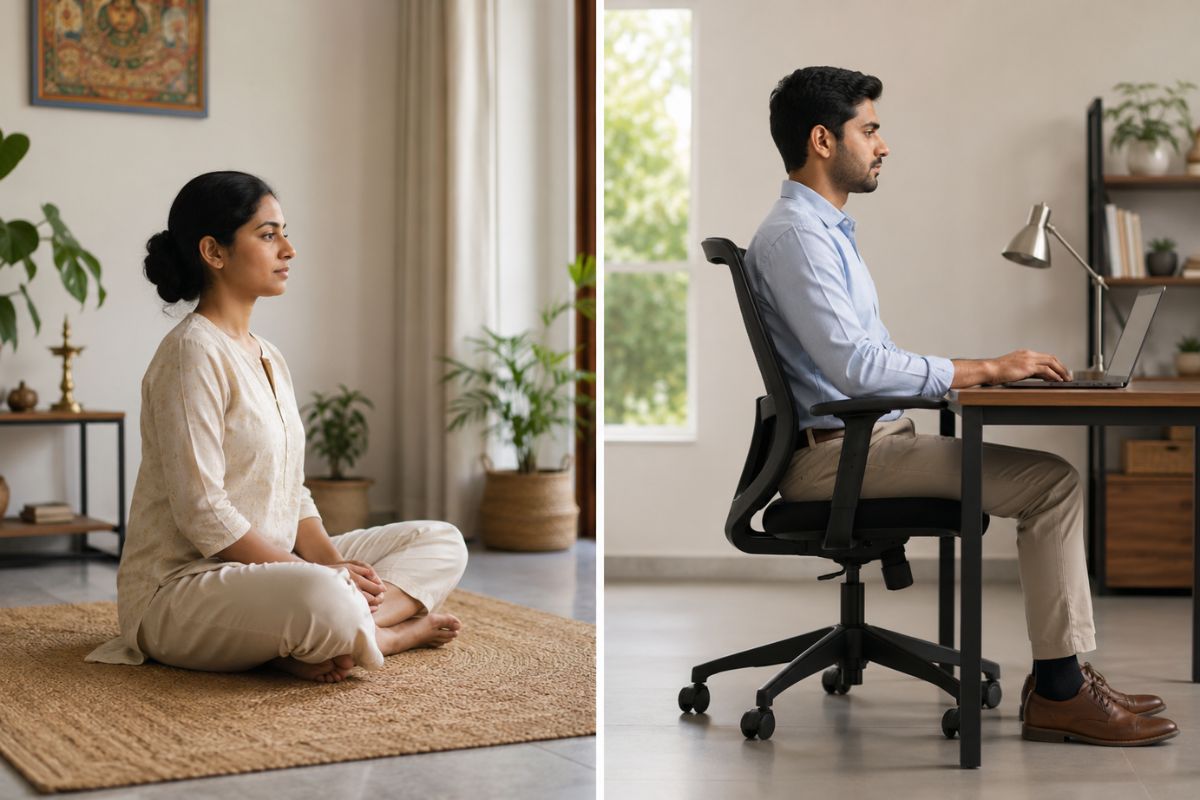
Walk into most Indian homes, and you’ll still find at least one spot where the floor does the job a chair does everywhere else – the dining space during meals, the corner set aside for puja, the mat someone pulls out for long evening conversations. Chairs took over most other rooms decades back, but that one habit never fully left.
So when wellness creators online started insisting floor sitting is secretly the healthier choice, plenty of Indians just nodded along, feeling vindicated, like something their grandparents always knew was finally getting validated by science. The actual research on the health effects of sitting on the floor vs. chairs turns out to be more complicated than either side of that argument usually lets on.
- Floor sitting improves hip mobility by up to 40% with consistent practice
- Traditionally, floor-sitting populations, including India, show 80 to 90% lower rates of hip arthritis
- A biomechanical study found that floor sitting actually increases lumbar spine pressure more than erect chair sitting
- Squatting has been linked to a higher risk of knee osteoarthritis, while cross-legged sitting appears safer
- Variation between positions throughout the day matters more than choosing one over the other
The Case for Floor Sitting
Sit cross-legged, kneel, or squat, and you’re asking something of your body that a chair simply never does. Hips, knees, ankles- all of them get pushed through ranges of motion, and a chair locks out entirely. People who sit on the floor regularly tend to show measurably better hip mobility, and some studies put that improvement as great as 40% with consistent practice. Given how stiff most desk-bound hips get after years of chairs, that’s a real number worth paying attention to.
There’s also a pattern across cultures that keeps showing up in research, even if nobody’s fully explained why yet. Places where floor sitting stayed part of daily life, large parts of India among them, along with China and Japan, report dramatically lower hip and knee arthritis rates than countries that left floors behind for chairs generations ago, with some figures showing 80 to 90% less hip arthritis in those floor-sitting populations. Nobody’s claiming this proves floor sitting alone is the cause; diet, genetics and general activity all play a part too, but researchers keep circling back to this pattern because it’s hard to ignore entirely.
There’s a physical strength angle too. Every time you lower yourself onto the floor and push back up, your legs and core are doing real work, lifting your full bodyweight without anything to hold onto. That repetition compounds into genuine functional strength as the years go by, which matters more than people realise when it comes to avoiding falls later in life. Some researchers now actually use the ability to get up off the floor unaided as a rough marker for predicting how long someone is likely to live.
Then there’s the constant small movement. Without a chair back locking you into one shape, your body naturally fidgets and resettles throughout the time you’re sitting, which keeps blood moving through your legs better and cuts down on that heavy, swollen feeling that builds up after a long stretch in an office chair.
Also Read: Quick 10-Minute Breakfasts That Actually Work for Busy Indians
Where the Science Gets More Complicated
Here’s where it’s important to be honest rather than just agreeable. A finite element study published through the National Centre for Biotechnology Information looked specifically at pressure on the lumbar spine across different sitting postures, standing, erect chair sitting, slumped chair sitting, and floor sitting. The findings complicate the simple floor good, chair bad narrative considerably.
Floor sitting actually generated the highest pressure on the nucleus pulposus and annulus fibrosus, the cushioning structures inside your spinal discs, even higher than slumped chair sitting. The reason came down to lumbar lordosis, the natural inward curve of your lower spine. Floor sitting tends to flatten that curve more than even poor chair posture does, which increases load on the spine during movement. The study concluded that an erect, well-supported chair posture with maintained lumbar curve actually produced the lowest spinal pressure of all the postures tested.
This doesn’t cancel out floor sitting’s benefits for hip mobility or its cultural and digestive advantages, but it does mean the spine story is more nuanced than wellness content usually presents it. Research out of Staffordshire University adds a similar caveat: there’s reasonable evidence that sitting cross-legged on the floor is less harmful than other floor positions like squatting or sitting with legs extended, and that squatting specifically has been flagged as a risk factor for knee osteoarthritis in some studies, the opposite of what you’d expect from the broader floor-sitting narrative.
Also Read: The Indoor Plant Guide for Every Indian Home, Big or Small
What Does this Actually Mean for You?
The honest takeaway is that neither position wins outright, and the real enemy is staying in any single position for too long. Whether you’re cross-legged on the floor for an hour or slumped in an office chair for the same duration, your spine and joints both suffer from the lack of variation, not from the surface you’re sitting on.
For most people in India already living with a mix of both- floor sitting during meals, on the bed, or during prayer, and chairs for desk work- that natural variation is probably already doing more good than either position would alone. If you sit at a desk all day, deliberately adding short stretches of floor sitting, cross-legged specifically rather than squatting, can genuinely help offset hip tightness. If you already spend a lot of time on the floor, building in some supported chair time with good lumbar posture protects your lower back from the pressure the spinal research identified.
Start gradually if floor sitting is new to you. Five minutes at a time, building up slowly, rather than forcing an hour-long cross-legged session that leaves your knees and ankles in protest the next day. Mild fatigue in the muscles is normal as your body adapts. Sharp pain anywhere is your signal to shift position immediately.
The health effects of sitting on the floor vs. chairs aren’t a contest with a clear winner. It’s a reminder that the human body was built to move through many positions, not to be locked into just one, regardless of which one you’ve been told is healthier.
Also Read: Offbeat Places to Visit in Northeast India That Most Travellers Still Haven’t Found
FAQs
Is sitting on the floor actually better for your back than a chair?
Not entirely. While floor sitting improves hip mobility and is linked to lower arthritis rates in floor-sitting cultures, a biomechanical study found floor sitting actually puts more pressure on the lumbar spine than erect chair sitting with proper lumbar support.
Does floor sitting really improve hip flexibility?
Yes, this is one of the most consistently supported benefits. Floor sitting moves your hips, knees, and ankles through a wider range of motion than chair sitting, with some research showing up to 40% improvement in hip mobility with regular practice.
Why do floor-sitting cultures have lower rates of arthritis?
Researchers believe it’s linked to the repeated joint movement involved in getting up and down from the floor throughout the day, though diet and overall activity levels likely contribute as well.
Is squatting on the floor bad for your knees?
Some research has flagged squatting, alongside cycling, as a risk factor for knee osteoarthritis, while cross-legged sitting appears to carry less risk than squatting or sitting with extended legs.
Should I switch entirely from chairs to floor sitting?
Most evidence points toward variation being more beneficial than committing fully to either position. A mix of both, with attention to posture in each, appears to offer the most balanced outcome for joint and spinal health.
Sources and References
- National Centre for Biotechnology Information – Biomechanical Effects of Different Sitting Postures on the Lumbar Spine
- The Conversation – Sitting on the Floor vs Sitting on a Chair, Which Is Better for You
- Staffordshire University Biomechanics Blog – Sitting on the Floor vs a Chair
- Healthline – Sitting on the Floor: Benefits, Precautions, and Best Positions
- Upright Pose – Sitting on the Floor: 7 Benefits Chairs Can’t Give
- The Ready State – Is Sitting on the Floor Good for You